Categories
DH Pedagogy Trip Report

Digital Pedagogy at LACOL

It’s my first blog post for DH @ W&L! Hi, everyone! I’m Sydney Bufkin, the new Mellon Digital Humanties Fellow. I have been—and will continue to be—a Visiting Assistant Professor in the English Department, so if I look familiar when you drop by my office, that’s likely why, especially if you’ve taken WRIT 100 in the past two years.
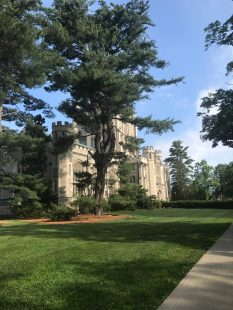
Photo of one of the Vassar academic buildings
The Vassar campus isn’t terrible in June

I moved over to the library last week and immediately hit the road for the Liberal Arts Consortium for Online Learning (LACOL) workshop at Vassar College. LACOL is a consortium of nine liberal arts colleges formed to share resources about online learning, blended learning and digital pedagogy, and to collaborate on projects across the consortium campuses. The consortium has held three workshops since beginning in 2014, as well as a number of hack-a-thons and mini-workshops on topics such as adaptive learning, language instruction, social annotation and others.

Washington and Lee joined LACOL this year, so this was the first workshop not only for me, but for the other W&L folks, as well. I was particularly excited about the workshop because I’m all about digital pedagogy, especially using technology to make the liberal arts classroom even more active and engaged than it traditionally is. I’m also interested in the future of higher education (for both professional and philosophical reasons), and I’ve watched with some trepidation as for-profit tech startups like Udacity and EdX have shifted the trajectory of higher ed in recent years. I like that the folks at LACOL are thinking about smaller educational units like the SPOC (small, private online course) rather than the MOOC (massive, open online course), while still exploring ways to make higher education more equitable and more accessible.

One of the highlights of the workshop was a keynote by Bryan Alexander, an “internationally known futurist, researcher, writer, speaker, consultant, and teacher, working in the field of how technology transforms education.” Bryan opened his talk with an image from Jonathan Edwards’s “Sinners in the Hands of an Angry God,” just in case there was any confusion about his assessment of the direction higher ed is heading. His talk raced through a long list of hard truths, from the growing inequality in the United States to decreased enrollments and increased financial pressures on nonprofit, four-year colleges. He noted that small liberal arts colleges represent just 5% of college students in the US, but have an outsized profile and visibility relative to that market share. He called on those colleges to meet the changing landscape of higher education by adapting in ways that improve access to education not just for students from privileged backgrounds, but for everyone.

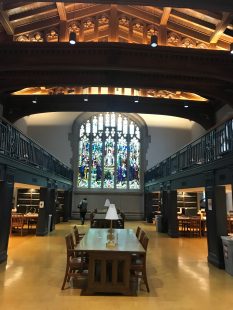
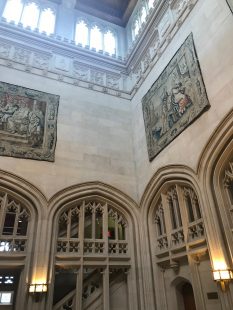
Bryan’s fire and brimstone was set in opposition to the beautiful Vassar campus, especially the breath-taking library. I only had a little bit of time there, but I spent several minutes taking in the arches and stained glass.
I attended working group sessions for LACOL’s Active and Engaged Reading group and came away with lots of ideas about what reading looks like in our screen-saturated moment. Once question the group considered was why we don’t generally teach the reading process in the way we teach the writing process. We often think of reading as something you either can do or you can’t, sort of like riding a bicycle, but it’s much more akin to writing—you have to identify different disciplines, genres and situations and know how best to read for each case. And like writing well, reading effectively is neither magic nor something you soak up through intuition; it’s a set of steps and processes you learn to apply and adapt.

The working group surveyed some tools and technologies that can help us be better readers, from low-tech approaches like group read-ins in the library and professors modeling their own reading practices to annotating tools like Lacuna and Hypothes.is. I was excited share the Critical Reader’s Toolkit, a project I worked on when I was at the University of Texas that helps demystify the reading process for literature students.

We had opportunities to hear from other people, both formally and informally, who are working on digital pedagogy at colleges around the country. Bryn Mawr just introduced a new digital competencies framework that emphasizes a number of key skills, including “Digital Survival Skills.” Lots of people were interested in questions of digital citizenship and digital competencies, and we had a lively brainstorming session about how we might collaborate across institutions to address digital fluency.

I always come back from conferences and workshops with my brain buzzing, and this was no exception. I’m excited to see what LACOL does next.
Categories
Announcement

Now Hiring: Director of Data Education

We’re hiring a Director of Data Education! Please see the complete job ad for more details. Review of applications will begin July 5 and continue until the position is filled.


Washington and Lee University Library invites applications for Director of Data Education, a non-tenure track faculty appointment, to establish a program to:

• engage faculty and students in incorporating statistical and computational data analysis methods (data science) into the undergraduate curriculum and scholarship;
• provide guidance for students in finding data sets as well as teaching students how to clean and manipulate data for use in analytical and statistical applications;
• offer peer tutoring to students who need assistance with data and statistical applications.

The program will make a significant contribution toward meeting the increasing demand for data-intensive courses as well as promoting data and statistical literacy across the curriculum. We are interested in candidates from all areas of statistical sciences and analytics, in the broadest possible sense, to teach skills with broad, real-world application.

Categories
DH Pedagogy UVA Collaboration

Why To Teach Students to Not-Read Novels

[Enjoy this guest post by James Ascher, doctoral candidate in the English Department at University Virginia. He came to W&L to give a workshop in Prof. Taylor Walle’s ENGL 335 course through a Mellon-funded collaboration with the Scholars’ Lab at UVA. More information about this initiative can be found here. His post is cross-listed on the Scholars’ Lab blog.]

This post has a simple argument: if you teach novels, you should teach students to not-read novels. Now, before you get concerned, I’m not arguing against teaching literature or avoiding novels altogether; the hyphen in “not-read” means a method, not a rejection of reading. Indeed, my whole argument is based on the idea that students need help returning careful attention to texts, but faced with a deluge of texts, we teachers ought to show them how some professional literary critics not-read, or as others call it “distant read.”

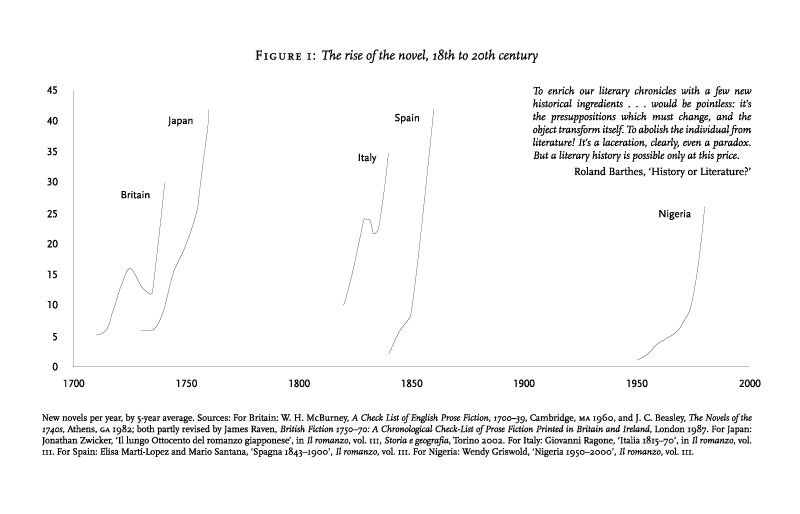
What is a novel anyhow? A reasonable question to ask your students as a semester goes along, since it seems to be a long form of prose that comes to dominate what we now consider literature. If one is to believe Amazon Rankings, then the most read forms of electronic books and the most purchased books remain novels (at least when I wrote this, but I’d be surprised if it changes). This wasn’t always the case and part of the history of the novel is its commercial success. Franco Moretti makes the case clear in his Graphs, Maps, and Trees where he argues that the rise of the novel can be studied using charts, as he does in his previous work Atlas of the European Novel (Moretti’s response, which is more useful.) Building on the idea of charting large-scale phenomena over time, he notices that novels rise (fig. 1).

Fig. 1 rises of novels from Graphs, Maps, and Trees

Fig. 1 rises of novels from Graphs, Maps, and Trees

Something about the form, the markets, the people, or something else means that this particular literary form comes to dominate, so whatever time period you consider, it’s worth considering what was going on.

Its well established that the English novel rose first—the form seems to have been invented there—so even in a non-English classroom, it’s worth considering how those novels were imported into a broader literary discourse. Luckily, the text of most eighteenth-century English novels are freely available online. We have a fortuitous confluence of the intellectually important materials that have become technologically available (a careful reader will note that this is one possible explanation of the novel’s rise as well). But, how can you study the features of a whole genre? An easy way is to read them by putting them on your syllabus, which I encourage, but after reading them you can look back at the whole syllabus and chart the topics that come up.

Fig. 2 Novel topics

Fig. 2 Novel topics

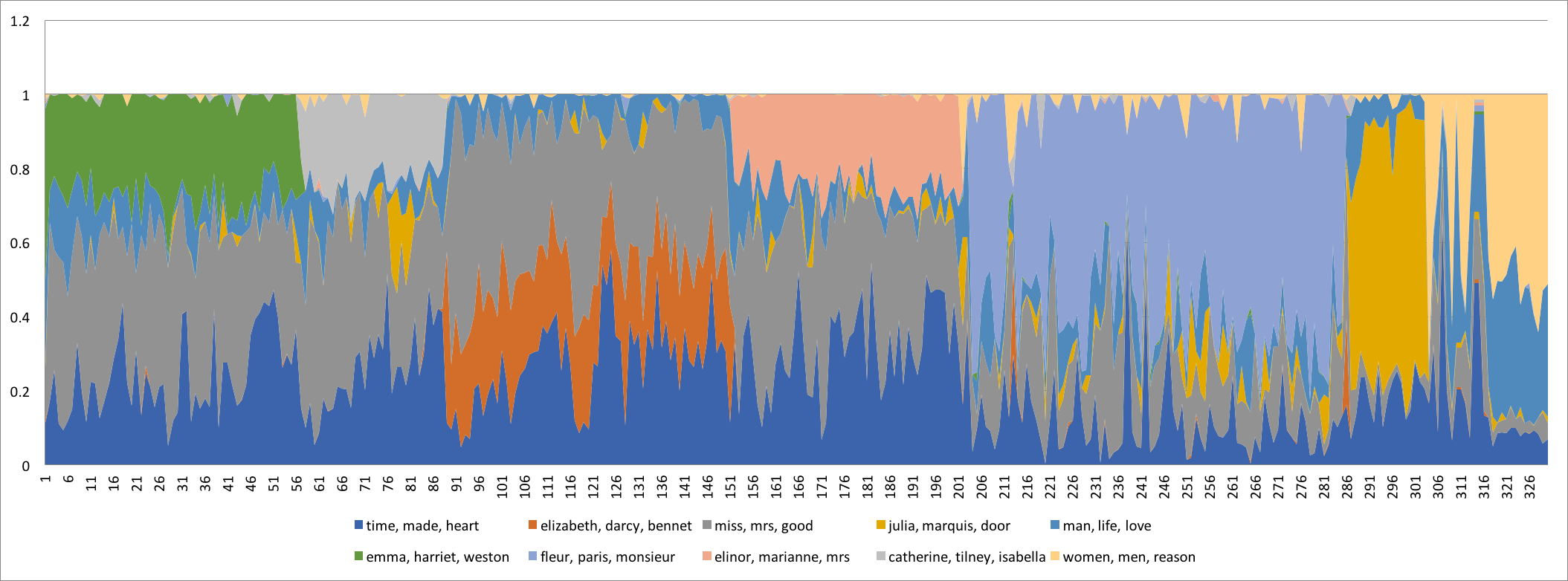
To test this idea, I presented for Taylor Walle in her English 335 “Radical Jane: the Politics of Class, Gender, and Race in Austen’s ‘Polite’ Fiction.” Her course asked students to think about how English novels formed identities and related to the growing issues of British society. It seemed like a great chance to try some topic-modeling across her entire syllabus, the chart was produced with ten topics across the whole class (fig. 2). You can see the lesson here if you want to reproduce the work.

After demonstrating how the method works, we turned to this chart and looked for topics that crossed the texts. The works read for the class and on the chart—from left to right—are Emma, Northanger Abbey, Pride and Prejudice, Sense and Sensibility, A Sentimental Journey, A Sicilian Romance, and A Vindication of the Rights of Woman. You can see, and the class immediately saw, that the topics broke at the boundaries of books. You can see that many of the topics to detect specific books, but a few cross boundaries. Now, the topic used in topic modeling isn’t quite the normal sense of the word “topic.” It means a list of words with probabilities that, when they occur, signal the topic that is that list of words. The topics by their top words are,

time made heart letter moment feelings mind spirits happiness
present long felt thought affection left hope return day love
situation ...

elizabeth darcy bennet jane bingley wickham collins mrs sister
lydia catherine lady lizzy longbourn gardiner father family
netherfield kitty charlotte ...

miss mrs good great dear young make time room house give day
thought friend heard man home replied pleasure hear ...

julia marquis door ferdinand madame hippolitus castle heart duke
heard marchioness length appeared light night discovered time part
count scene ...

man life love woman character mind world society sense opinion
great beauty good present taste nature understanding husband
degree subject ...

emma harriet weston mrs knightley elton thing jane woodhouse miss
fairfax frank churchill body hartfield bates highbury father sort
harriet's ...

fleur paris monsieur poor hand count thou man set told madame good
french thy heart lady tis put made nature ...

elinor marianne mrs dashwood edward jennings sister willoughby
colonel lucy john mother thing brandon ferrars barton middleton
marianne's lady town ...

catherine tilney isabella thorpe morland allen general henry bath
eleanor catherine's brother james father street hour northanger
abbey john captain ...

women men reason virtue sex respect mind duties affection make
heart children power render human virtues true allowed till duty
...

As far as the course goes, the first topic seems to cover what all these texts have in common, but notice everything isn’t perfectly lined up by novel. The topic beginning “julia marquis door” clearly comes from Sicilian Romance, but also hits on some later chapters of Northanger Abbey. Why would that be? Well, if you know the texts, you realize that some of the same Gothic themes occur in both texts and they use the same words.—“Dear students, can anyone bring us to where in the text this happens?” And, we enter the realm of the normal literature classroom.

By presenting a broad view of the texts, built by a computer algorithm, but out of the words of the text, we invite students to re-read works. Not-reading becomes re-reading and presenting words across the entire corpus puts students into partnership with technology to ask what it is about the form of novelistic prose that makes it popular and speak to social issues. Furthermore, we also encourage students to be critical of the results of computerized analysis. Several students noted that these topics were obvious, having read the works, and that they could have come up with them by hand, which is—of course—true. It’s easy to scale these up beyond what you could do by hand, but seeing how they reflect what is accurately in the text shows that they provide some purchase on truth and also suggests what might be going on with other computerized analyses. One way we imagined it was that the computer applied an obvious rule at a fine level of detail. If we follow the same method, but only for Emma by paragraph, we get a much messier chart (fig. 3), but seeing that chart, students can begin to engage with both literary texts and computers that help them to not read—to ask what it means and what can be done with it.

Emma by chapter

Fig. 3 Emma by paragraph

Categories
Announcement DH

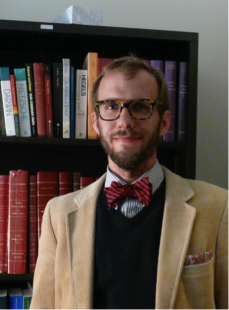
Announcing Our New Mellon DH Fellow: Sydney Bufkin

Sydney Bufkin Headshot
We are happy to announce our new Mellon DH Fellow, Sydney Bufkin. Sydney is a familiar face for many of us at W&L as she’s been teaching in the English Department for the last few years. Sydney received her PhD in English from the University of Texas at Austin with a specialization in nineteenth-century American literature and reception studies. At W&L, Sydney has taught a range of courses in the English Department and Writing Program. She specializes in digital approaches to pedagogy and has received a DH incentive grant for her multi-modal writing assignments. Her interest in computational approaches to literature manifests itself in her own research on a corpus of reviews of nineteenth-century purpose fiction and hopefully in future DH courses!

Sydney will being on June 12. Please welcome her to her new role in Leyburn Library.

Categories
DH Trip Report

Days of Networks & Social Capital

Enabling faculty and students to attend high-quality workshops is one of the most valued opportunities supported by our Mellon DH grant. I recently returned from a 4-day trip to Philadelphia with Jon Eastwood (Laurent Boetsch Term Professor of Sociology) and three brilliant undergrads at W&L: Elena Diller, C’17 (Sociology major with minors in Poverty Studies and Women, Gender, and Sexuality Studies ), Dani Leon, C’18 (Politics/Sociology double major with a minor in Poverty Studies), and Kassie Scott (English/Sociology double major with a minor in Poverty Studies). Jon attended a workshop on Casual Inference with Directed Graphs taught by Felix Elwert; Elena, Dani, Kassie, and I attended a workshop on Social Network Analysis (SNA) taught by Steve Borgatti. The latter workshop was recommended to us by Professor Megan Hess (Accounting), who had taken a workshop with Borgatti before. Both short courses were hosted by Statistical Horizons.

This post will focus on the SNA workshop, though we all learned a fascinating amount about Directed Acyclic Graphs from Jon Eastwood over meals and during the long drive back from Philadelphia. Jon reports that he will be bringing what he learned into the classroom this Fall Term as part of the course he will be teaching on Bayesian data analysis.

The workshop was two intensive days, 9-5, that provided an in-depth introduction to SNA, particularly with the use of the UCINET software package developed by Borgatti. The W&L students were the only undergrads in attendance, which is an indicator of the quality of opportunities that this university provides students. The class size was 28, consisting mostly of faculty, professionals in fields such as public health, government, and social work, as well as a few grad students. Medical school faculty were prominently represented. The W&L undergrads, not shy about asking questions, easily kept up with their more educated classmates.

The instructor, Steve Borgatti, is one of the leading scholars in the field. Borgatti is currently president of the International Network for Social Network Analysis and has published a wealth of literature that has received over 40,000 citations. Borgatti is a humble man whose jovial and bearded presence in blue jeans never conveys any hint of his standing within academia. The pace of the workshop was intense, thought provoking, and exhausting but well worth the effort. Borgatti structured the 2-day workshop as a mixture of lecture (with over 200 slides) and hands-on practice with UCINET. Attendees came away with an understanding of how to import different data structures into UCINET and the many network measures provided by the software.

As a Windows program, UCINET works well on Macs via the Windows emulator Wine. Step-by-step instructions for installing on a Mac via WineBottler work really well. My one bit of advice on installation for Macs is to make a symbolic link to the UCINET data folder, which is installed by WineBottler at “/Users/[username]/Library/Application Support/com.yourcompany.yourapp[numeric string]/drive_c/users/[username]/My Documents/UCINET data”. A symbolic link from your Desktop or elsewhere will make it easy to access the data files generated by UCINET.

UCINET is a good alternative for people who prefer a menu-driven interface over the command-driven approach of R. I would definitely recommend UCINET over Gephi. For my own SNA research, I suspect I will stick with R’s igraph package but I’m going to explore the possibilities of UCINET. As far as software goes, UCINET is simple to learn. It mostly works the same way for any feature or network measure: find the desired option under the menus, load the data set, set any additional options, and run. UCINET also comes with a command-line interface. The extensive HELP file provides references to scholarly articles for a large number of functions provided by the software.

Due to the computational nature of SNA, people new to the topic often approach it as a methodology or a tool. Borgatti emphasizes a distinction between the “theory of networks” as a way of explaining why networks exist and “network theory” as a way of understanding the consequences of networks. Borgatti stated that most SNA studies are about the consequences of networks.

A significant part of the second day of the workshop focused on egonets, which is a network focused on one person (the “ego”) and the connections that person has with others (the “alters”). Building on that discussion was an examination of social resource theory, associated with the scholar Nan Lin. Another conception of social capital is articulated by scholar Ron Burt via network analysis in the form of structural holes.

A variety of measures exist for SNA but I’m finding in my own research into literary networks that absorbing the network theory before embarking on the actual data analysis is having a positive impact on my understanding of the patterns and connections within literary publishing. Previously I have thrown my data set into network visualization tools as a means of exploring the data but I now feel better equipped to think about exactly which measures I should examine for better understanding the interchange among editors and authors in producing the outcome that is a literary magazine.

Borgatti covered a great number of topics in the two days, including a very mathematical discussion of the types of regression that can be done on network matrices. He also gave an overview of exponential random graph models (ERGMs) as a computational model for predicting the absence or presence of connections within a network.

SNA is not just about contemporary issues. Borgatti used the data set from a well-known study on the relationship of marriage and business ties among 15th century Florentine families that led to the rise of the Medici. Another historical topic covered was a study of 12th century Russia and the emergence of Moscow as a dominant location due to trade routes. In the latter study, we see that SNA can be applied to areas other than just interpersonal relationships. As Borgatti says, “Networks are everywhere” and network studies are found in the natural sciences, the social sciences, and the humanities.

I already mentioned the professional organization INSNA, which tends to focus on the social sciences. Another organization, the Network Science Society, focuses more on physics, computer science, biology, etc. While there is overlap among the two professional organizations, Borgatti describes the two as still “having a different feel”.

I’ll wrap up this report with a suggested reading. Just about anything by Borgatti is worthwhile, and a good starting point is his 2009 article in Science on Network Analysis in the Social Sciences. I highly recommend reading about the theories behind social network analysis and how those apply to your own research questions. Grasping those concepts before jumping into the tools of SNA will be very beneficial. Borgatti and his colleagues at the University of Kentucky’s LINKS Center for Social Network Analysis also have published an insightful article on Social Network Research: Confusions, Criticisms, and Controversies [PDF preprint].

Categories
Event on campus Speaker Series

DH Speaker Series: Jeffrey Witt

Join us for the final DH Speaker of the 2016-2017 academic year. Jeffrey Witt, Assistant Professor of Philosophy at Loyola University Maryland, will be speaking on “The Scholastic Commentaries and Texts Archive: Reconceiving the Medieval Corpus in a Linked Data World.”

Monday, May 8, 2017
12:15-1:15pm
Hillel 101
Lunch provided, please register.


photo of jeffrey witt
Jeffrey Witt is an assistant professor of philosophy at Loyola University Maryland. He is the founder, designer, and developer of the Scholastic Commentaries and Texts Archive and the LombardPress-Web publication system. He is working on several editions of previously unedited Latin texts, aiming to make them freely available and searchable on the web. He sits on the advisory board of the Digital Latin Library and is co-chair the IIIF Manuscript Community Group. In 2016, he was awarded a Visiting Research Fellowship at the Schoenberg Institute for Manuscript Studies at the University of Pennsylvania to develop TEI transcriptions of the Sentences commentary of William de Rothwell and to incorporate those transcriptions into the Scholastics Commentaries and Texts Archive. Jeffrey Witt completed his graduate work in the philosophy department at Boston College in the spring of 2012. His dissertation focused on issues of faith, reason, and theological knowledge in the late medieval Sentences commentaries. He is the co-editor of The Theology of John Mair (Brill 2015) and the co-author of a monograph on the 14th century philosopher and theologian Robert Holcot (Oxford University Press, 2016).

This program made possible by the Andrew W. Mellon Foundation, Italian Studies, and Medieval and Renaissance Studies

Categories
Announcement Project Update Undergraduate Fellows

Work in Progress: Updates from Our DH Fellows

Join us on April 4th from 2-4pm to hear project updates from our current Mellon DH Undergraduate Fellows. If you’re interested in becoming a fellow next year, this is the perfect chance to learn what it’s all about!

Applications are now open for the 2017-2018 academic year.

We’ll be in the DH Workspace (Leyburn 218). There will be snacks.

Categories
DH Pedagogy UVA Collaboration

The Long and Messy History of Privacy

[Enjoy this guest post by Shane Lin, a PhD Student in the Corcoran Department of History at the University of Virginia. He came to W&L to give a workshop through a Mellon-funded collaboration with the Scholars’ Lab at UVA. More information about this initiative can be found here. His post is cross-listed on the Scholars’ Lab blog.]

I was invited by Brandon Walsh, the Mellon Digital Humanities Fellow at Washington and Lee and a former Scholars’ Lab Praxis fellow of my cohort, to come to W&L as part of an ongoing collaboration between W&L and the Scholars’ Lab. The program pairs UVA graduate students with W&L undergraduate students studying a relevant subject and gives the former the opportunity to expose the latter to new modes of digital scholarship.

I was fortunate to be matched with Brandon’s own English composition class: “Writing in the Age of Digital Surveillance”. My dissertation research is on the history of cryptography and the construction of digital privacy rights from the mid-1970s through the 1990s and involves a text analysis project examining influential privacy-related Usenet newsgroups and mailing list messages, so this seemed like a perfect match.

My first instinct was to give a quick rehash of my work, an introduction to modern cryptography, and a few hands-on exercises in code-making and code-breaking. I could also reuse a demonstration I used from the last time I taught undergraduate students: how to anonymously buy cocaine on the darkweb with cryptocurrency.

Yet none of these approaches seemed quite appropriate. Brandon had done a good job. The syllabus showed that the students had engaged very closely with the ramifications of modern technology on surveillance, drawing on thinkers like Siva Vaidhyanathan and Clay Shirky. My research, though focused narrowly on cryptography, interfaced with so many of the big ideas that the students had already broached. I didn’t want to bore them with historical detail (“scholarly rigor”!) or to just rehash the broader themes they were already well familiar with. Nor did I think that it was entirely appropriate to give a workshop on cryptography tools or on digital research techniques in a writing class. It didn’t seem very useful to throw prime factorization or Python web scraping libraries at these unsuspecting students for a single class.

I was supposed to speak about DH and digital technology, but Brandon assured me that I had wide latitude to choose the topic. So I decided to hardly mention computers at all and talk instead about privacy in the context of the fundamental idea of history: things change. Privacy is not a fixed principle. The abstract notion of privacy rights is a very modern construction and even the practical, everyday conception of physical privacy has radically shifted through history, owing much to the affordances of technologies we may not think of as having much to do at all with privacy.

I started by examining evidence of privacy in ancient Greece and how quantitative research on ruins has shown that prioritization of privacy was built into the architecture of Mediterranean homes. We discussed the rise of public bathing and its shifting practices and cultural significance under the Roman empire. And we spoke of the etymology of the word “eavesdrop” and its political connotations during the rein of Henry VIII. This was followed by a tour through the communications infrastructure of the early American republic and the role of the revolutionary and partisan presses and the post office in democratizing privacy by broadening access to both subversive ideas and the means to convey them. Finally, we discussed the dynamic legal conception of privacy, from the Fourth Amendment’s originally weak protections against searches to the landmark 1967 Katz v. United States decision that codified an expectation of privacy based solely in the realm of ideas.

Digital technology was the end-point of this crooked journey. Though they have dramatically altered our understandings of privacy and the topography of power that supports such conceptions, the rights that these technologies challenged or championed were forged through centuries of history. Focusing on just the most recent debate wrongly implies that digital technologies are uniquely potent mechanisms and that the shifting landscape of privacy in our tremulous times represents a singular historical moment. I thought it was important to put our modern, contested notion of privacy in broader context, a context that includes the changes wrought by aqueducts, fire pits, chimneys, printing presses, bureaucratic organization, and other earlier technologies of decidedly analog mode.

Categories
DH Pedagogy

On Co-Teaching and Digital Humanities

[Crossposted to my personal blog.]

For me, co-teaching is the ultimate teaching experience. I’ve been fortunate to find several opportunities for it over the years. During graduate school, I co-taught a number of short courses, several DH classes, and a couple workshops. Here at W&L I’ve been able to teach alongside faculty from the history department and the Library. Each experience has been deeply rewarding. These days I’m spending more time thinking about digital humanities from a curricular and pedagogical standpoint, so I wanted to offer a few quick notes on how co-teaching might play a role in those discussions.

I’m sympathetic to arguments against putting two or more people at the front of the classroom. It’s expensive to use two faculty members to teach a single course when one might do, so I can understand how, in a certain logic, the format seems profoundly inefficient. You have a set number of courses that need to be taught, and you need people to teach them. And I have also heard people say that co-teaching is a lot more work than teaching a course solo. I understand these objections. But I wanted to offer just a few notes on the benefits of co-teaching – why you might want to consider it as a path for growing your digital humanities program even in the face of such hesitations. I’ve found that the co-teaching experience fully compliments the work that we do as digital humanists for a number of reasons. I think of co-teaching as a way to make the teaching of digital humanities more fully reflect the ways we tend to practice it.

Co-teaching allows for more interdisciplinary courses.

Interdisciplinarity is hard. By its very nature, it assumes research, thinking, and teaching that lie at the intersections of at least two fields, usually more. In the case of digital humanities, this is exacerbated because the methodologies of the combined fields often seem to be so distinct from one another. Literary criticism and statistical methods, archival research and computer science, literary theory and web design. These binaries are flawed, of course, and these fields have a lot to say to and about each other. But, in the context of teaching digital humanities, sometimes bringing these fields together requires expertise that one teacher alone might not possess. A second instructor makes it easier to bridge perceived gaps in skills or training. And those skills, if they are meant to be taught, require time and energy from the instructors. On a more practical level, it can be profoundly helpful to have one instructor float in the classroom to offer technical assistance while the other leads discussion so as to prevent troubleshooting from breaking up the class. It is not enough to say that interdisciplinary courses need a second instructor. They often require additional hands on deck.

Co-teaching models collaboration for students.

Digital humanities work often requires multiple people to work together, but I’d wager that students often expect there to be a single person in charge of a class. Students might come into the class expecting a lecture model. Or, at the very least, they might expect the teacher to be an expert on the material. Or, they might expect the instructor to lead discussion. These formats are all well and good, and many instructors thrive on these models. I prefer to position my students as equal collaborators with me in the material of the course. We explore the material together, and, even if I might serve as a guiding hand, their observations are just as important as my own. I try to give my students space to assert themselves as experts, as real collaborators in the course. Co-teaching helps to set the stage for this kind of approach, because the baseline assumption is that no one person knows everything. If that were the case, you would not need a second instructor. There is always a second voice in the room. By unsettling the top-down hierarchy of the classroom, co-teaching helps to disperse authority out into other parts of the group. The co-teacher not in charge on a particular day might even be seated alongside the students, learning with them. This approach to teaching works especially well as a vehicle for digital humanities. After all, most digital humanities projects have many collaborators, each of whom brings a different set of skills to the table. No person operates as an expert in all parts of a collaborative project – not even the project manager. Digital humanities work is, by its nature, collaborative. Students should know this, see this, and feel this, and it can start at the front of the classroom.

Co-teaching transfers skills from one instructor to another.

Digital humanities faculty and staff are often brought in to support courses and projects by teaching particular methods or tools. This kind of training can sometimes happen in one-off workshops or in external labs, but the co-teaching model can offer a deeper, more immersive mentoring experience. Co-teaching can be as much for the instruction of the students as it is for the professional development of the teachers. For the willing faculty member, a semester-long engagement with material that stretches their own technical abilities can set them up to teach the material by themselves in the future. They can learn alongside the students and expand their portfolio of skills. At W&L we have had successes in a number of disciplines with this approach – faculty in history, journalism, and French have expanded their skills with text analysis, multimedia design and storytelling, and textual encoding all while developing and teaching new courses. We’ve even managed, at times, to document this process so that we have demonstrable, professionally legible evidence of the kinds of work possible when two people work together. When both instructors share course time for the entire semester it can help to expand the capacity of a digital humanities program by spreading expertise among many collaborators.

Of course, all of this requires a lot of buy-in, both from the faculty teaching together and from the administration overseeing the development of such courses. You need a lot of people ready to see the value in this process. The particulars of your campus might provide their own limitations or opportunities. Putting together collaborations like these takes time and energy, but it’s worth it. I think of co-teaching as an investment – in the future of the program, the students, and the instructors. What requires two instructors today might, with the right preparation and participation, only require one tomorrow.

In case you want to read more, here are some other pieces on co-teaching from myself and past collaborators (happy to be pointed to others!):

Categories
Announcement DH

DH Courses Coming This Fall

Though most of us can’t see beyond winter term, fall registration is almost here! We have two DH courses on offer this fall. Check them out!


DH 102: Data in the Humanities

This course introduces students to the creation and visualization of data in humanities research. The course is predicated on the fact that the digital turn of the last several decades has drastically changed the nature of knowledge production and distribution. The community and set of practices that is digital humanities (DH) encourages fluency in media beyond the printed word such as text mining, digital curation, data visualization, and spatial analysis. Readings and discussions of theory complement hands-on application of digital methods and computational thinking. While the objects of our study come primarily from the humanities, the methods of analysis are widely applicable to the social and natural sciences. Three unit-long collaborative projects explore the creation, structure, and visualization of humanities data. This course meets in two-hour blocks to accommodate a lab component.

Prof. Mackenzie Brooks // TR 2:30-4:30pm // SC FDR // course website

DH 110: Programming for Non-Programmers

Computer science and IT graduates are no longer the only people expected to have some knowledge of how to program. Humanities and social science majors can greatly increase their job prospects by understanding the fundamentals of writing computer code, not only through the ability itself but also being better able to communicate with programming professionals and comprehending the software development and design process as a whole. The most centralized and simple platform for learning is the Web. This course starts with a brief introduction to/review of HTML and CSS and then focuses on using JavaScript to write basic code and implement preexisting libraries to analyze and visualize data. Students become familiar with building a complete Web page that showcases all three languages.

Prof. Jason Mickel // MW 2:30p-3:55p, R 8:35a-10:00a // SC FDR // course website