Categories
Announcement DH Pedagogy Publication Tools

Introduction to Text Analysis: A Coursebook

[Crossposted on my personal blog.]

I am happy to share publicly the initial release of a project that I have been shopping around in various talks and presentations for a while now. This semester, I co-taught a course on “Scandal, Crime, and Spectacle in the 19th Century” with Professor Sarah Horowitz in the history department here at Washington and Lee University. The course counted as digital humanities credit for our students, who were given a quick and dirty introduction to text analysis over the course of the term. In preparing for the class, I knew that I wanted my teaching materials on text analysis to be publicly available for others to use and learn from. One option might be to blog aggressively during the semester, but I worried that I would let the project slide, particularly once teaching got underway. Early conversations with Professor Horowitz suggested, instead, that we take advantage of time that we both had over the summer and experiment. By assembling our lesson plans far in advance, we could collaboratively author them and share them in a format that would be legible for publication both to our students, colleagues, and a wider audience. I would learn from her, she from me, and the product would be a set of resources useful to others.

At a later date I will write more on the collaboration, particularly on how the co-writing process was a way for both of us to build our digital skill sets. For now, though, I want to share the results of our work – Introduction to Text Analysis: A Coursebook. The materials here served as the backbone to roughly a one-credit introduction in text analysis, but we aimed to make them as modular as possible so that they could be reworked into other contexts. By compartmentalizing text analysis concepts, tool discussions, and exercises that integrate both, we hopefully made it a little easier for an interested instructor to pull out pieces for their own needs. All our materials are on GitHub, so use them to your heart’s content. If you are a really ambitious instructor, you can take a look at our section on Adapting this Book for information on how to clone and spin up your own copy of the text materials. While the current platform complicates this process, as I’ll mention in a moment, I’m working to mitigate those issues. Most importantly to me, the book focuses on concepts and tools without actually introducing a programming language or (hopefully) getting too technical. While there were costs to these decisions, they were meant to make any part of the book accessible for complete newcomers, even if they haven’t read the preceding chapters. The book is really written with a student audience in mind, and we have the cute animal photos to prove it. Check out the Preface and Introduction to the book for more information about the thinking that went into it.

The work is, by necessity, schematic and incomplete. Rather than suggesting that this be the definitive book on the subject (how could anything ever be?), we want to suggest that we always benefit from iteration. More teaching materials always help. Any resource can be a good one – bad examples can be productive failures. So we encourage you to build upon these materials in your courses, workshops, or otherwise. We also welcome feedback on these resources. If you see something that you want to discuss, question, or contest, please drop us a line on our GitHub issues page. This work has already benefited from the kind feedback of others, either explicit or implicit, and we are happy to receive any suggestions that can improve the materials for others.

One last thing – this project was an experiment in open and collaborative publishing. In the process of writing the book, it became clear that the platform we used for producing it – GitBook – was becoming a problem. The platform was fantastic for spinning up a quick collaboration, and it really paid dividends in its ease of use for writers new to Markdown and version control. But the service is new and under heavy development. Ultimately, the code is out of our control, and I want something more stable and more fully in my hands for long-term sustainability. I am in the process of transferring the materials to a Jekyll installation that would run off GitHub pages. Rather than wait for this final, archive version of the site to be complete, it seemed better to release this current working version out into the world. I will update all the links here once I migrate things over. If the current hosting site is down, you can download a PDF copy of the most recent version of the book here.

Categories
DH Research Projects Undergraduate Fellows

Markdown and Manuscripts

What I’m Currently Working On:


The Commissione of Gerolimo Morosini is a late 17th century manuscript that
serves simultaneously as a letter of appointment, a professional code of
conduct, and a list of legal actions and precedents. It was issued to Morosini,
a Venetian noble from a prominent family, by Doge Marcantonio Giustinian, whose
short reign of four years helps to accurately date the work. Currently housed
in Washington and Lee’s own Special Collections, working with this text offers
me a rare opportunity in several ways:

  • Commissioni are unique, as no more than two copies of each were ever made,
    meaning little, if any, research has already examined this piece
  • Transcribing and translating the text allows me to apply the Italian I am
    learning in class this year
  • Working with an item such as this might normally happen in graduate school,
    but I’m beginning this project as a sophomore

Needless to say, I’m extremely excited to have this chance to make some really
cool discoveries. But the problem with transcribing a manuscript, regardless
of its age, became apparent the very moment I began. How closely should I
replicate the appearance and context of the original text? In a poetic work,
elements such as enjambment and line breaks have an impact on the reader’s
perception of the work, and therefore ought to be preserved. Prose lacks these
restrictions, and may be rendered in a less restrictive format, but the issue
of chapters, titles, page numbers, and more can still pose a problem. No two
projects are identical, and it is up to the researcher to decide how to
approach the text.

Because the manuscript I am working on was written in prose and not verse, and
the text lacks page numbers and other identifying features, I have decided to
transcribe it in a manner as close to plaintext as possible. To this end I
have made use of Markdown, a simple way to format text without all the
complexity of a markup language like HTML or XML/TEI. It’s also very easy to
export to these formats later on, so Markdown presents the best option for me
to start transcribing as quickly and painlessly as possible.

While plaintext is great for its simplicity, it still helps to have a few more
features that Notepad lacks. Using the text editor Atom allows me to keep
track of particular elements by highlighting Markdown syntax, as seen here:

“Atom”

Items in orange are bold and indicate important sections of text, such as
passage headers/titles. Items in purple have been italicized by me, indicating
a word whose spelling or transcription I am not 100% certain of. I’ve used
dashes to indicate a hard-to-read letter and the pound symbol (not a hashtag!)
for headers to indicate recto and folio pages for my own ease of use.

As I spend more time working with the manuscript and studying Italian, I’ll go
back and edit the text appropriately. The ultimate goal for this project is to
have the entire commissione transcribed and then translated into English,
with both the Italian and English versions encoded using TEI/XML and made
publicly available.

– Aidan Valente

Categories
DH Event on campus

DH Workspace Open House on October 21

DH Workspace Open House 10/21/16 1-4pm Leyburn 218

Join us as we celebrate the opening of our new Digital Humanities Workspace. Located on Lower Level 2, this workspace provides dedicated office and collaboration space for our two DH-dedicated faculty: Mackenzie Brooks (Digital Humanities Librarian) and Brandon Walsh (Mellon Digital Humanities Fellow). Planning for the space began over a year ago, inspired by a visit to DHi at Hamilton College.

Stop by Friday afternoon to check out our cool desks or just to share what you’ve been working on recently. We are planning to hold more open office hours in the future so stay tuned!

Categories
DH Undergraduate Fellows

Third and Final Fellow Intro: Hayley!

Hi all! My name is Hayley Soutter and I’m the most recent student to join the Digital Humanities Fellowship program. I want to start off by saying that, before I was offered a spot on this team, I really wasn’t sure what it would entail. I thought I might be required to code (which I did not know how to do whatsoever) or design a webpage all on my own. But because I am a Mass Communications and Art History major, I figured I would apply for the program to see if it would combine my humanity-driven interests with my desire to learn more about digital media.

I have always been a student who favored the humanities. I was never very good at science or math growing up. In high school, I was heavily involved in the photojournalism department; I worked as both a reporter and an editor for our yearbook- writing stories, designing page layouts, taking photographs or proofreading copy. While I loved working for my yearbook during high school, I wasn’t sure how I wanted to continue my passion at W&L. I knew early on that I didn’t want to pursue a degree in journalism, but I wanted something that combined writing, creativity and technology under one umbrella.
This past summer, I was an intern at The High Museum of Art in Atlanta, Georgia. During my eight weeks there, I enjoyed working on many social media and technology-related projects. I wrote Instagram and Twitter posts for the museum, in addition to enhancing their Tumblr presence. I also helped the digital technology team redesign the museum’s entire website. I loved the digital media aspect of my internship and I wanted to develop my technological skills further once I got back to school. I learned of the DH Fellowship through an outreach to the journalism department and thought it sounded like the perfect opportunity for me! I’m only a few weeks in, but so far, the internship has been a great experience and I have learned a ton already (including how to code a little). I know the skills I am learning will help me when I enter the “real world” in just a few short months by opening up more opportunities for me in my prospective career path. The DH team is awesome, and I’m so excited for the projects and collaborations to come this year.

Categories
DH Undergraduate Fellows

DH Fellows Intro: Aidan V.

Hello! I’m Aidan Valente, a sophomore from Sanford, Florida and the second of the three Mellon Fellows this year. I’m a Medieval and Renaissance Studies and Art History double-major who fell down the rabbit hole that is Digital Humanities rather recently, but I’ve enjoyed the crazy and decided to stay.

When I first entered W&L, I thought I would declare a Computer Science major (mostly due to my belief that it would ensure a viable career four years later). I have since then “seen the light” and dedicated myself to the humanities, preferring Italian art and manuscripts to dry lectures on writing code. That’s not to say I don’t enjoy programming—I do, just not to the extent that a CSCI degree requires.

I first discovered Digital Humanities by chance rather than through any concerted effort on my behalf. As I looked through the course catalog for Winter ’16 classes, I noticed a 1-credit course entitled “DH Studio: Text Encoding.” The description, though somewhat vague, piqued my interest enough for me to sign up for it; what I didn’t know was that the course acted as a co-requisite for another class I was completely unaware of. Despite this initial registration faux pas, I stuck with it and learned about XML, TEI, and digital humanities in general under Mackenzie Brooks. My experience indirectly led to an amazing summer opportunity with Special Collections, which in turn has allowed me to set the groundwork for my work this year on several DH projects I have envisioned.

What I enjoy most about DH are its collaborative nature and the applicability it has in so many areas, both in and out of the classroom. Many of the professors I’ve had utilize DH projects as part of their research, and several of my friends spent this summer working on initiatives such as the Ancient Graffiti Project. My own project ideas involve a number of Italian manuscripts and early print books found in Special Collections. As an MRST major with Professor McCormick for an advisor, I also hope to contribute to his Huon d’Auvergne project in the near future. I’ve still got a lot to learn, both in terms of code and humanities studies, but I hope to continue my DH experience throughout the rest of my college career and, hopefully, long after I graduate, too.

Categories
DH Undergraduate Fellows

Hello World! I’m Abdur ✌🏾

Hey everyone! My name is Abdur Khan and I’m a senior from Perrysburg, Ohio. I’m a French major, originally pre-med but I think it’s time to declare myself on the DH path instead.

When I came to W&L, I accidentally got into the habit of taking classes that connect really well with each other. One semester, my intro biology class was about drugs and how they act, and I also took a psychology class about psychoactive drugs. Another semester, genetics and biochemistry overlapped just as well. Last winter term, I took intro to programming and learned the basics of programming with Python, while for my French class, I learned the basics of HTML, CSS, and XML. This latest overlap is what really brought me to the digital humanities. I was aware of the field and I vaguely knew what it involved, and even had friends taking the intro course, but I never really realized what “digital humanities” really meant until I started exploring it for myself.

Lately, it seems like everything I do is centered around technology and computers. I worked at the ITS HelpDesk over the summer and worked with Professor McCormick on his Huon d’Auvergne project. I’ve never really thought about this but it was interesting working on two different aspects of technology. There was the hardware and the professional side at work, and during and after, I would work on the software and the academic side of things. There’s not as much overlap as you’d expect between the two sides, but having those experiences has been extremely valuable and I think they’re steadily pushing me towards a career in technology. My command of Python and knowledge of command line (hacking stuff) has already come in handy. I wrote a script in Python, with a lot of help from Brandon, that made my work with Prof. McCormick easier, and later wrote another code that simplified another process for us. Writing my own code that wasn’t for an assignment for a comp-sci lab was honestly exhilarating, as nerdy as that sounds. I can’t remember applying knowledge from a class and using it the same way for a practical solution, so doing that for the first time and now doing it on a regular basis makes things feel real in a way that being at college hasn’t before.

Getting so heavily involved in DH so fast makes me think that I should keep exploring the opportunities in this field. That’s why I applied for a DH fellowship and how I wound up writing an honors thesis that’s about half DH-based. I’m really excited to keep learning about the digital humanities and their applications and I’d like to see where they take me after graduation.

Categories
DH Pedagogy

Text Analysis Workshop: Four Ways to Read a Text

[Cross-posted on my personal blog.]

On Monday I visited Mackenzie Brooks‘s course on “Data in the Humanities” to introduce digital text analysis to her students. I faced a few challenges when planning for the visit:

  • Scope – I had two hours for the workshop and a lot of material to cover. I was meant to introduce anything and everything, as much as I wanted in a general overview of text analysis.
  • Background – This course is an introductory digital humanities course that counts as a science credit at W&L, so I assumed no prior knowledge of programming. Mackenzie will be covering some things with them later in the course, but at this stage I needed to avoid anything really technical.
  • Length – Two hours was both a lot of time and no time at all. It was certainly not enough time to teach anyone to program for the first time. As an aside, I often find it hard to gauge how much material is appropriate for anything longer than 75 minutes.
  • Content – Since this was meant to be a general overview of the field, I did not want to lean too heavily on analysis by tools. I worried that if I did so the takeaway for the students would be how to use the tools, not the underlying concepts that the tools aided them in exploring.

I wound up developing a workshop I called “Introduction to Text Analysis: Four Ways to Read a Text.” Focusing on four ways meant that I felt comfortable cutting a section if things started to go long. It also meant that I was developing a workshop model that could easily fit varying lengths in the future. For example, I’ll be using portions of this workshop throughout my introduction to text analysis lectures in my own course this fall. The approach would necessarily be pretty distant – I couldn’t go into much detail for any one method in this time. Finally, I wanted the students to think about text analysis concepts first and then come to tools that would help them to do so, so I tried to displace the tools and projects from the conversation slightly. The hope was that, by enacting or intuiting the methods by hand first, the concepts would stick more easily than they might otherwise.

The basic structure of the workshop was this:

  1. I introduce a basic methodology for reading.
  2. Students are presented with a handout asking them to read in a particular way with a prompt from me. They complete the exercise.
  3. We talk about the process. We clarify the concept a little more together, and the students infer some of the basic difficulties and affordances of the approach.
  4. Then I show a couple tools and projects that use that method for real results.

The four ways of reading I covered were close reading, bags of words, topic modeling, and sentiment analysis. So, to use the topic modeling portion as an example, any one of those units looked something like this:

  1. I note how, until now, we have been discussing how counting words gives us a sense of the overall topic or scope of the text. Over time and in close proximity, individual words combine to give us a sense of what a text is about.
  2. I give the students three paragraphs with the words scrambled and out of order (done pretty quickly in Python). I ask the students to get in groups and tell me what the underlying topics or themes are for each excerpt. They had to produce three single-word topics for each paragraph, and paragraphs could share topics.
  3. We talk about how were able to determine the topics of the texts even with the paragraphs virtually unreadable. Even out of order, certain words in proximity together suggest the underlying theme of a text. We can think of texts as made up of a series of topics like these, clusters of words that occur in noticeable patterns near one another. We have human limits as to how much we can comprehend, but computers can help us run similar, mathematical versions of the same process to find out what words occur near each other in statistically significant patterns. The results can be thought of as the underlying topics or discourses that make up a series of documents. A lot of hand waving, I know, but I am assuming here that students will examine topic modeling in more detail at a later date. Better, I think, to introduce the broad strokes than lose students in the details.
  4. I then share Mining the Dispatch as an example of topic modeling in action to show the students the kinds of research questions that can be explored using this method.

So, in essence, what I tried to do is create a hands-on approach to teaching text analysis concepts that is flexible enough to fit a variety of needs and contexts. My handouts and slides are all up on a github repository. Feel free to share, reuse, and remix them in any way you would like.


Categories
DH Event on campus Speaker Series

Ed Ayers to speak September 22

Ed Ayers portrait
September 22, 2016
7pm
Lee Chapel
Open to all, no tickets required.

We are thrilled to welcome Ed Ayers to campus as a distinguished guest in our Speaker Series.

The title of Ayers’ talk, which is free and open to the public, is “The Puzzle of the American Civil War and Reconstruction.”

Ayers has written and edited 11 books including “The Promise of the New South: Life after Reconstruction,” which was a finalist for both the National Book Award and the Pulitzer Prize. “In the Presence of Mine Enemies: Civil War in the Heart of America, 1859-1863” won the Bancroft Prize for distinguished writing in American history. A pioneer in digital history, Ayers’ website, “The Valley of the Shadow: Two Communities in the American Civil War,” has attracted millions of users and has won major prizes in teaching of history. He serves as co-editor of the Atlas of the Historical Geography of the United States at the University of Richmond’s Digital Scholarship Lab and is a co-host of BackStory with the American History Guys, a nationally syndicated radio show and podcast.

This program is made possible by a grant from the Andrew W. Mellon Foundation.

Categories
DH Event on campus Speaker Series

Geolocation: Tributes to the Data Stream

Artists’ talk and reception:
Thursday, September 15, 2016
5:30pm
Wilson Hall/Concert Hall and Lykes Atrium

The exhibit runs September 1-24, 2016 in Staniar Gallery.


We are partnering with the Staniar Gallery to present this collaborative project by photographers Nate Larson and Marni Shindelman who use publicly available GPS coordinates from Twitter messages to find and photograph the location where the Tweet originated. The pictures are then presented with the text that inspired them to create poetic pairings, which range from sorrowful to humorous, confessional to cheeky. The project has garnered much attention for its exploration of contemporary cultural dichotomies such as public/private, real/virtual, analog/digital. Geolocation has been widely exhibited and featured in such publications as Wired Magazine, The New York Times Lens Blog, VICE Magazine, Discover Magazine, The Washinton Post and Utne Reader. Larson and Shindelman will be visiting Journalism and DH courses during their visit.

This program is made possible by a grant from the Andrew W. Mellon Foundation in partnership with the Staniar Gallery.

Categories
DH Incentive Grants Pedagogy

Kelli Shermeyer on “Using DH to Explore Movement and Meaning”

Enjoy this guest post by Kelli Shermeyer, Doctoral candidate in the UVA English department, in which she describes her work with Professor Holly Pickett’s English 380 course at W&L. This work is supported by an ASC grant expanding collaboration between W&L and the Scholars’ Lab. Cross-posted on the Scholars’ Lab blog.

“Playwrights write plays for the stage, not the study,” or so Roland Broude reminds us.[i] Yet in my field of English literature, it’s quite common to study a play primarily as a textual object rather than a performance whose final form, tone, and affect all rely on extra-textual features. We don’t typically account for changes in play’s text during its first rehearsals (often these changes are implemented after the play text has been sent to print!), refinements in timing and intonation that occur during a show’s run, or even accidental line drops, forgotten words, or ad libs contrived by actors in reaction to something that happened during a particular performance. The reality of theater is that plays are constantly rewritten in a multitude of ways and we don’t have a lot of good ways to talk about that beyond acknowledgement.

In our world of the single-author study and the copyright, one of the consequences of seeing dramatic texts primarily as “literature” is the following assumption that the play is entirely the property of its author, who, as Broude argues, “exercises over it a droît moral: his is the sole right to establish the text, and, once it has been established, to alter it.”[ii] Teaching from this paradigm limits engagement with the performer or designer’s role in creating the play’s affect or meaning.

My work as a teacher, researcher, and theater director is to employ the digital humanities to help create ways that empower students to see a play as a complex nexus of decisions rather than a static textual object (for even the text itself is not stable). The problem that quickly surfaces is that performance (in many of its forms) is actually rather tricky to write about, because while we may have access to many versions and editions of the textual object (script), each enactment of that script is essentially ephemeral—a portion of it remains unrecoupable.

Peggy Phelan has claimed that the ontology of performance is essentially its irreproducibility[iii] and she acknowledges the difficulty this presents in analyzing performance art. We can try to fix parts of performance in a variety of non-performative forms such as narrative, photograph, or video recording, but those other media can only offer ekphrasis, not full reproduction. The ephemerality of performance gives it much of its affective weight and political potential. While we may not be able to entirely recapture performance outside of ekphrasis, my hope is that we can develop tools and methods for examining dramatic texts and performances that can help us to translate some of the harder-to-capture elements of performance into forms on which we can engage in various kinds of analysis or reflection.[iv] One of the questions I am currently thinking through is how can we “read” movement?

There’s some interesting work from the dance world that begins to think through these issues. Choreographer William Forsythe’s work with the Ohio State University (called Synchronous Objects) is particularly fascinating. Earlier work by choreographers such Rudolf Laban developed notational systems for dancers based on certain ideas about the body in space (Labanotation, for example).[v] But I’ve been struggling to try to find a way that connects movement and text (like a script) in a meaningful way. How do certain textual features invite us to think about certain movements? What in the text tells us to move to a particular place or in a particular way? Asking students these questions is also a way of approaching the critical practices like the close reading and formal analysis which still remains important to much (but not all!) of our work in literary studies.

As a way to experiment with the relationship between movement and language, I worked with Holly Pickett’s English 380 class on two activities to help us discuss the relationship between the text and blocking of a scene. (Blocking is both a noun and a verb: it describes both the pattern of movement in a given scene and the act of directing/designing those movement patterns in rehearsal). First, I gave them the “to be or not to be” monologue from Hamlet Act 3, scene 1. I selected this text because I thought it was one they may be marginally familiar with and one that doesn’t contain many stage directions within the language (for example, when a character says “come here,” cuing another actor’s movement).

I instructed them to draw Hamlet’s path throughout the monologue—where does he start, end, and where does he move throughout the speech? I did not give them any instructions on how to notate pauses, changing positions or how long Hamlet took to walk somewhere as I was interested in seeing how they would choose to notate this.

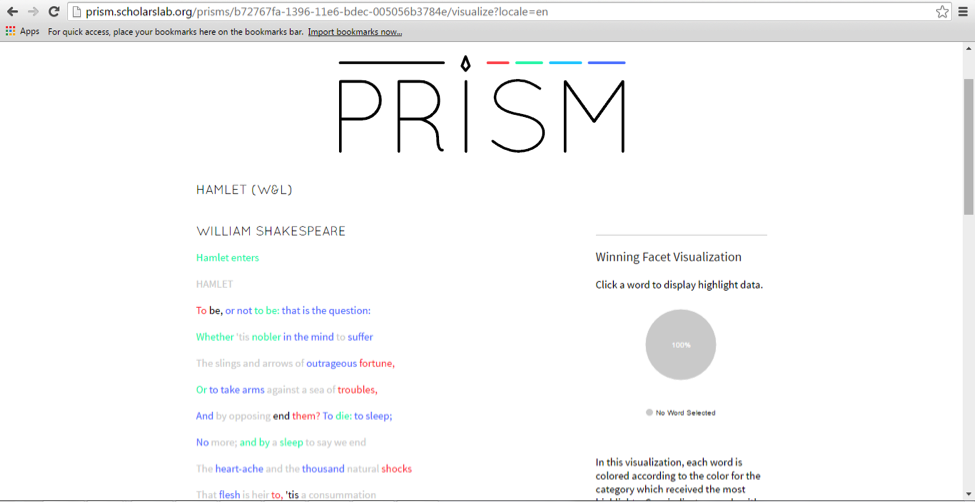
I also asked them to use Prism to mark up the monologue, indicating where Hamlet started moving, stopped moving, or changed position in their blocking. I did not tell them in which order to do these tasks just that they had to do both of them. At the end of the allotted 20 minutes, I taped all of the drawings on the board and pressed the visualization button on Prism to see what we found. The Prism results revealed that there was a great variety in blocking styles, yet there were definable loci of energy around certain parts of the text. (Here’s the full visualization)

In this first image, you can see that a lot of students notated something around “end them? To die; to sleep,” but there disagreement as to what Hamlet was doing at those moments.
prism 1

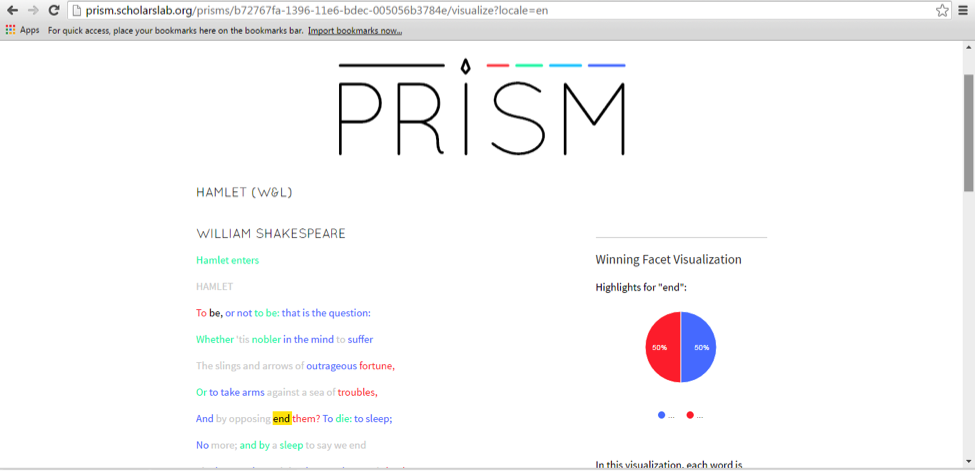
We zeroed in on the word “end” as Prism showed there was some debate as to what movement happened on that word. The Prism showed that students either had Hamlet change position without changing location (indicated by the blue) or stop moving all together (indicated by the red). No one had Hamlet begin moving on this word (which would have been indicated by green).
prism 2

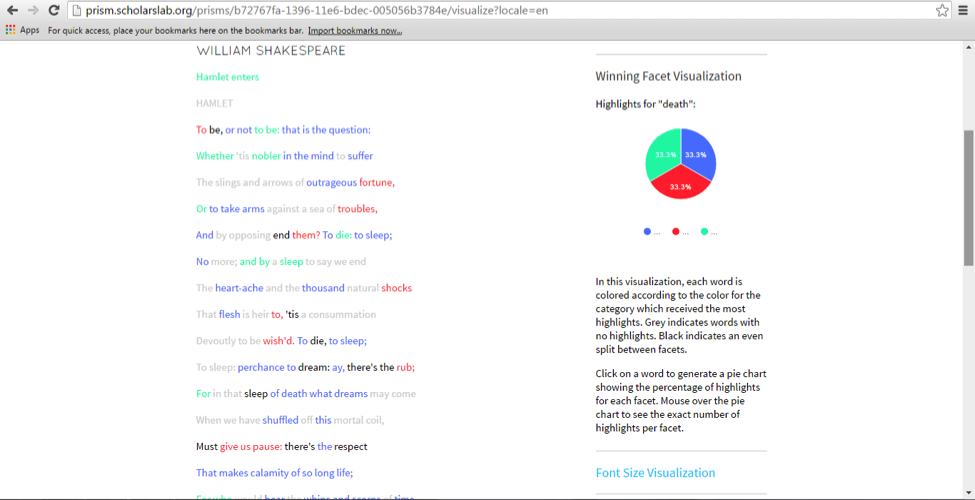
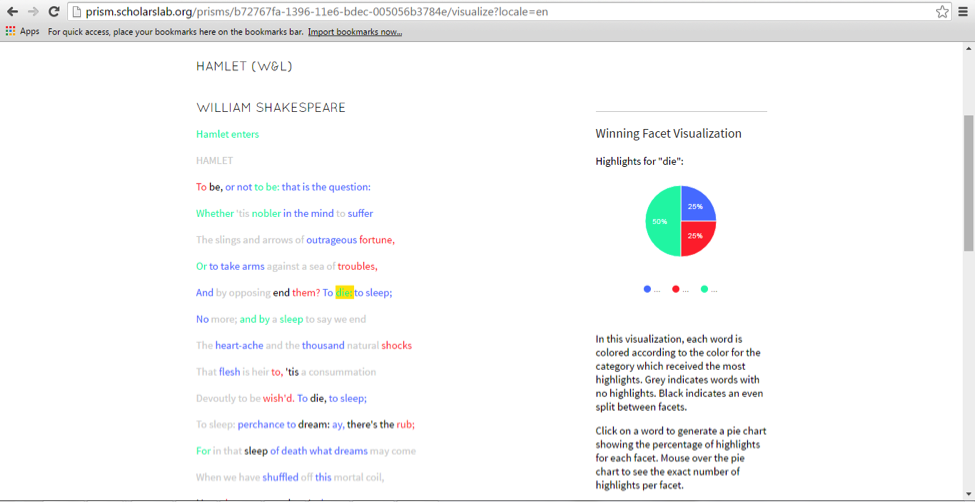
Throughout the whole monologue, “die” and “death” continued to appear as words where students thought some kind of movement or position change should occur, but we couldn’t agree as to what that movement should be:
prism 3

prism 4

I have no definitive way to explain this: only a director’s hunch that there’s some sort of affective energy around the word and concept of death that we associate with anxiety that incites us to movement—we (or at least most of us) do not want to be still when facing death. Part of my future work is figuring out how to interpret these results.

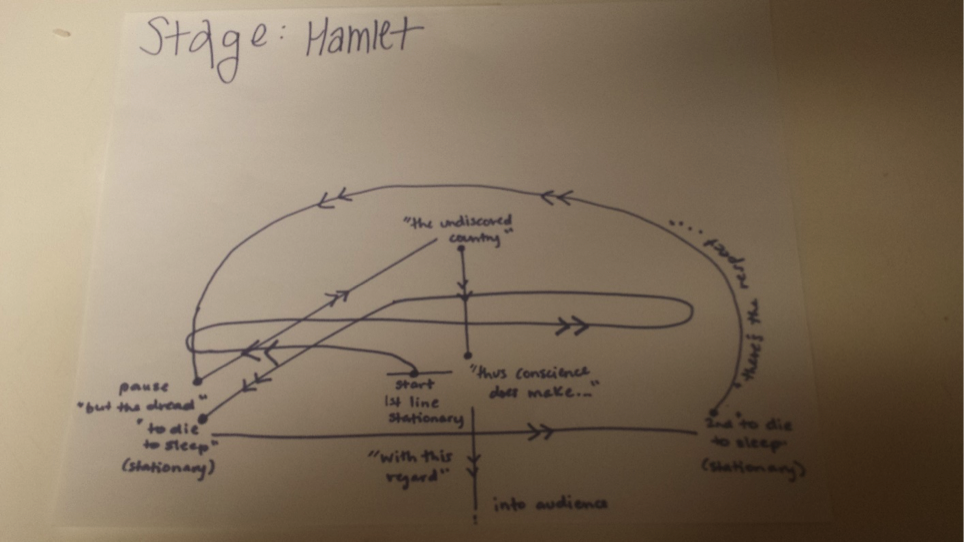
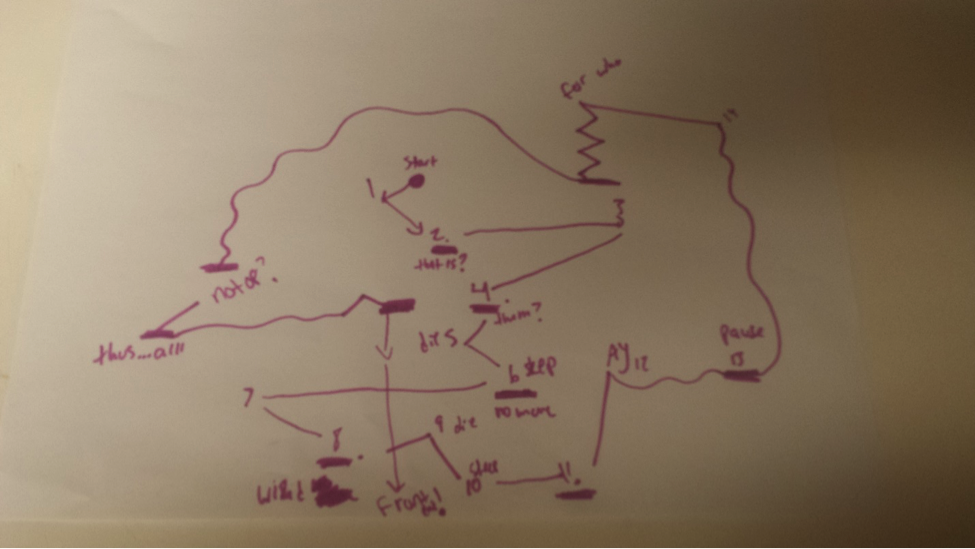
The other part of the activity—the drawings of Hamlet’s path—are much harder to read. Most drawings started Hamlet out on the center of the stage, not accounting for the first bit of text printed in the monologue directing that “Hamlet enters.” To me, this suggests some kind of connection between what we know about Hamlet, the role of this speech in the play, and center stage—we know Hamlet is the central figure and associate this important monologue with the center stage. But aside from that, the patterns varied. Most were well-balanced with Hamlet spending time on both sides of the stage (my mentors would be proud that both sides of the audience would get an equally good view of the actor). Some incorporated gestures or moments of intentional stillness. Many contained loops. Professor Pickett explained that she chose to do this in her drawing because of how she views the speech as rhetorically winding and wanted to create a movement pattern that reflected her reading.

Several of the students actually marked words on their drawings as well connecting the text directly to their movement patterns:
student hamlet

student hamlet 2

Some used no text at all and focused on the shape of Hamlet’s movements:
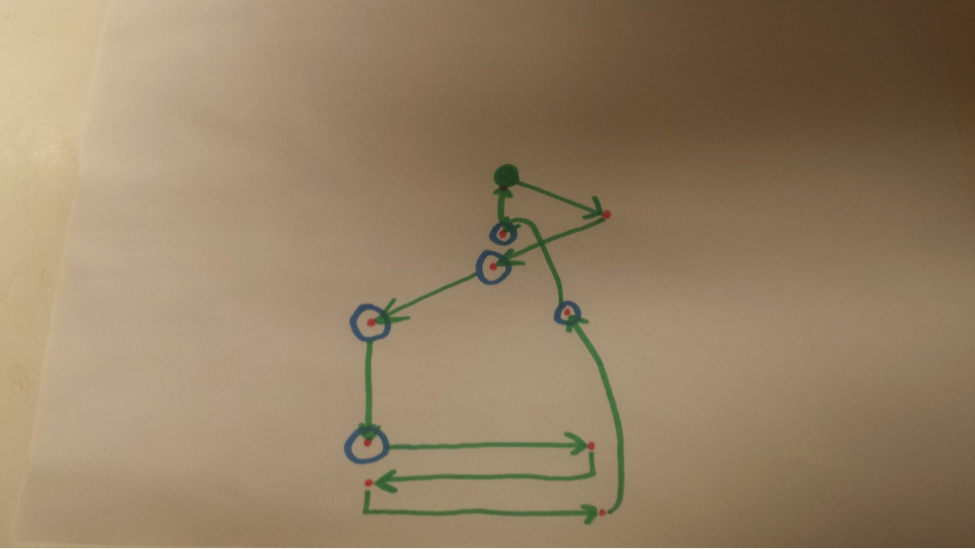
student hamlet 3

And here’s one that was purposely playing with Hamlet’s winding rhetoric:

student hamlet 4

So how do we make meaning out of all of this data?

I’m in the process (the slow, painful process) of developing a tool (or likely, a set of tools) to help students visualize the connection between play text and movement patterns. By considering the way language suggests movement will, I hope, allow for a richer consideration of the formal stylistics of particular plays, but also in the long run create corpus of data on the way people see theatre texts. I’m interested in what new areas of inquiry open up if I can use a digital tool to process many blocking patterns of the same scene (i.e. perform a kind of distant reading on the movement patterns that I had the students create). At the least, we can get students to think more deeply about the way that the dramatic text is a living document brought to life, challenged, and enriched by a consideration of the ways its interacts with the body, and embodiment.

This is important work for me both as a literary scholar and a theater director because of the reciprocal relationship between movement and interpretation. The director interprets the text to find places to block movement, and then the audience uses those movements to interpret certain moments on stage. Thinking about the relationship between movement and interpretation helps us to counter the belief that the playwright alone fixes the meaning of his or her “original text” and to recognize the larger networks of people, practices, traditions, and texts that make theater mean something.

[i] Broude, Roland. Performance and the Socialized Text. Textual Cultures: Texts, Contexts, Interpretation, Volume 6, Number 2, 2011, 24.

[ii] Ibid. 25.

[iii] Phelan, Peggy. Unmarked : The Politics of Performance. London ; Routledge, 1993.

[iv] It’s entirely worth noting that there should be a lively debate about if there are elements of performance that should not be recorded or analyzed as well. Is the kind of work we’re doing creating a richer context for talking about performances, or are we violently decontextualizing aspects of performance that can’t be understood without the full (but sadly unrecoverable) picture? (Many thanks to Purdom Linblad for first asking me a version of this question!)

[v] I was made aware of this interesting work in dance through sitting in on “The Art of Dance” taught by Kim Brooks Mata in the summer of 2015.