Categories
Event on campus Incentive Grants Speaker Series

Day of DH @ Fall Academy 2016

With the fall semester looming, the W&L campus is abuzz with preparations, including the annual Fall Academy. Two weeks of workshops on technology and pedagogy help faculty and staff get up to speed for the new academic year. We have chosen August 31st as our “Day of DH” – a chance to hear from our colleagues and guests about their DH course projects and methods. Don’t forget to register!

10-10:15am The Mellon Grant and You!
Come hear about the $800,000 Mellon Digital Humanities Grant and learn about new ways to fund your innovative teaching ideas, conference travel, research and undergraduate research assistants, as well as graduate student teaching support from UVa.
10:30-11:30am Incentive Grant Winners Panel
Owen Collins, Holly Pickett, Laura Brodie, and Claudette Artwick will discuss the nature of their projects, how the projects were structured, and what the outcomes were.
11:45am-1:30pm Writing: A Digital Humanity
The history of writing is intertwined with the history of it as technology, and its history as a humanity is intertwined with that of rhetoric and literature. Patricia Suzanne Sullivan and James P. Ascher offer a range of a easily adoptable assignments and activities to prompt experimentation, exploration, and reflection on writing as a technology in first-year (and other) writing courses.
Categories
Summer Research

Spotlight on Summer Research

If the humidity is any indication, we are well into summer here at W&L. While we do not hold classes in the summer, a number of students remain in Lexington to conduct research with faculty. To enable this research, we awarded four Summer Research Grants to faculty and students. Congrats to all – we can’t wait to see how your projects grow!


The Ancient Graffiti Project

Perhaps you’ve heard of this project before? Perhaps while reading The Atlantic or browsing Forbes? The Ancient Graffiti Project is one of our long-standing DH projects led by Profs. Rebecca Benefiel and Sara Sprenkle. Students have been integral to this project’s development and this summer is no different. Lillian MacDonald ’19 and Nathan Brewer ’18 joined Prof. Benefiel in Italy for fieldwork in June and have spent the remaining weeks of the summer processing the data they gathered. Alicia Martinez ’18 has been working with Prof. Sprenkle to refresh the APG website and develop new mapping functionality (supported by Lenfest funding). All three students presented their work at the Summer Research Scholars Brown Bag Lunch Series on July 12, 2016.

Visualizing Partisan Rangers During the American Civil War

This fledgling project is led by Barton Myers, Associate Professor of History. With the ultimate goal of visualizing spatial data on the Confederate government’s authorized guerrilla units of partisan rangers, Hannah Austin ’17, John Crum ’17, Zachary Howard ’17, Alex Kirven ’17 are spending their summer gathering data on these guerrilla units from the Fold3 database of historical military records. This project is also supported by the History in the Public Sphere Mellon Grant.

A Thanatography of Robert Devereux, 2nd Earl of Essex

Another long-standing DH project, Prof. Hank Dobin’s timeline and “LifeMap” of the 2nd Earl of Essex continues to grow. Cecilia Weingart ’19 is focusing on gender relations in contemporary novels about Essex as her contribution to the project. Additionally, Prof. Dobin has been working with Jeff Knudson, ITS, and Brandon Walsh, DH Mellon Fellow, to develop a crowdsourcing component to the timeline.

Steinheil: Sex, Scandal and Politics in Belle Époque France

Sarah Horowitz, Associate Professor of History, is joined by Sam Gibson ’17 and Brandon Walsh, DH Mellon Fellow, on this project to study the language of sensationalism in the French press of the early 20th century. Focusing on the Steinheil Affair, the team began by creating clean OCR transcriptions of newspaper articles for topic modeling and other text analysis methods. Sam presented at the Summer Research Scholars Brown Bag Lunch Series on June 29th, 2016, and the entire team will travel to Hamilton College in July to participate in the Institute for Liberal Arts Digital Scholarship. Check out their progress on Github!

This program made possible by a grant from the Andrew W. Mellon Foundation.

Categories
DH Incentive Grants Pedagogy

Kelli Shermeyer on “Using DH to Explore Movement and Meaning”

Enjoy this guest post by Kelli Shermeyer, Doctoral candidate in the UVA English department, in which she describes her work with Professor Holly Pickett’s English 380 course at W&L. This work is supported by an ASC grant expanding collaboration between W&L and the Scholars’ Lab. Cross-posted on the Scholars’ Lab blog.

“Playwrights write plays for the stage, not the study,” or so Roland Broude reminds us.[i] Yet in my field of English literature, it’s quite common to study a play primarily as a textual object rather than a performance whose final form, tone, and affect all rely on extra-textual features. We don’t typically account for changes in play’s text during its first rehearsals (often these changes are implemented after the play text has been sent to print!), refinements in timing and intonation that occur during a show’s run, or even accidental line drops, forgotten words, or ad libs contrived by actors in reaction to something that happened during a particular performance. The reality of theater is that plays are constantly rewritten in a multitude of ways and we don’t have a lot of good ways to talk about that beyond acknowledgement.

In our world of the single-author study and the copyright, one of the consequences of seeing dramatic texts primarily as “literature” is the following assumption that the play is entirely the property of its author, who, as Broude argues, “exercises over it a droît moral: his is the sole right to establish the text, and, once it has been established, to alter it.”[ii] Teaching from this paradigm limits engagement with the performer or designer’s role in creating the play’s affect or meaning.

My work as a teacher, researcher, and theater director is to employ the digital humanities to help create ways that empower students to see a play as a complex nexus of decisions rather than a static textual object (for even the text itself is not stable). The problem that quickly surfaces is that performance (in many of its forms) is actually rather tricky to write about, because while we may have access to many versions and editions of the textual object (script), each enactment of that script is essentially ephemeral—a portion of it remains unrecoupable.

Peggy Phelan has claimed that the ontology of performance is essentially its irreproducibility[iii] and she acknowledges the difficulty this presents in analyzing performance art. We can try to fix parts of performance in a variety of non-performative forms such as narrative, photograph, or video recording, but those other media can only offer ekphrasis, not full reproduction. The ephemerality of performance gives it much of its affective weight and political potential. While we may not be able to entirely recapture performance outside of ekphrasis, my hope is that we can develop tools and methods for examining dramatic texts and performances that can help us to translate some of the harder-to-capture elements of performance into forms on which we can engage in various kinds of analysis or reflection.[iv] One of the questions I am currently thinking through is how can we “read” movement?

There’s some interesting work from the dance world that begins to think through these issues. Choreographer William Forsythe’s work with the Ohio State University (called Synchronous Objects) is particularly fascinating. Earlier work by choreographers such Rudolf Laban developed notational systems for dancers based on certain ideas about the body in space (Labanotation, for example).[v] But I’ve been struggling to try to find a way that connects movement and text (like a script) in a meaningful way. How do certain textual features invite us to think about certain movements? What in the text tells us to move to a particular place or in a particular way? Asking students these questions is also a way of approaching the critical practices like the close reading and formal analysis which still remains important to much (but not all!) of our work in literary studies.

As a way to experiment with the relationship between movement and language, I worked with Holly Pickett’s English 380 class on two activities to help us discuss the relationship between the text and blocking of a scene. (Blocking is both a noun and a verb: it describes both the pattern of movement in a given scene and the act of directing/designing those movement patterns in rehearsal). First, I gave them the “to be or not to be” monologue from Hamlet Act 3, scene 1. I selected this text because I thought it was one they may be marginally familiar with and one that doesn’t contain many stage directions within the language (for example, when a character says “come here,” cuing another actor’s movement).

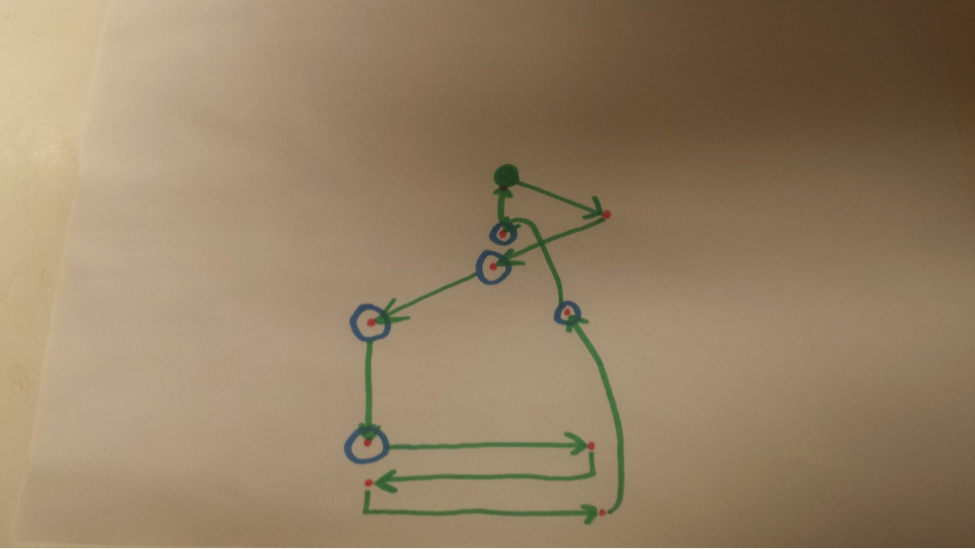
I instructed them to draw Hamlet’s path throughout the monologue—where does he start, end, and where does he move throughout the speech? I did not give them any instructions on how to notate pauses, changing positions or how long Hamlet took to walk somewhere as I was interested in seeing how they would choose to notate this.

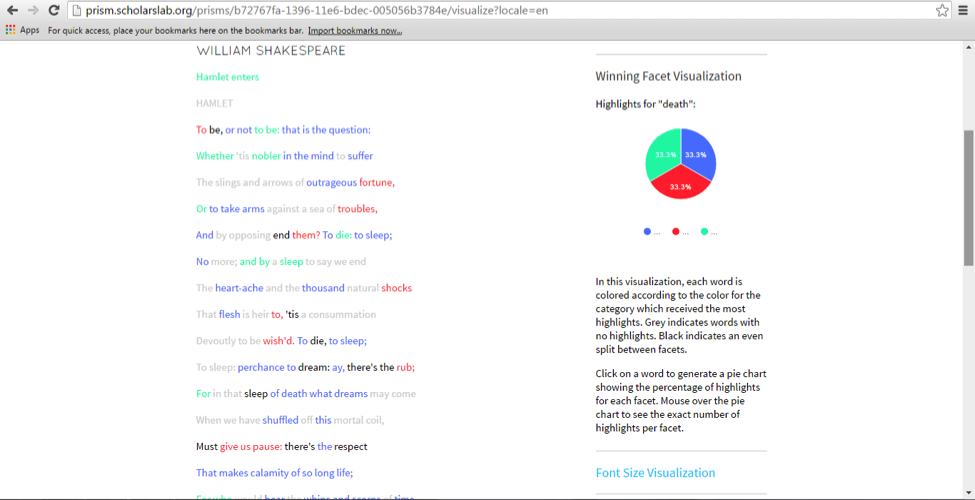
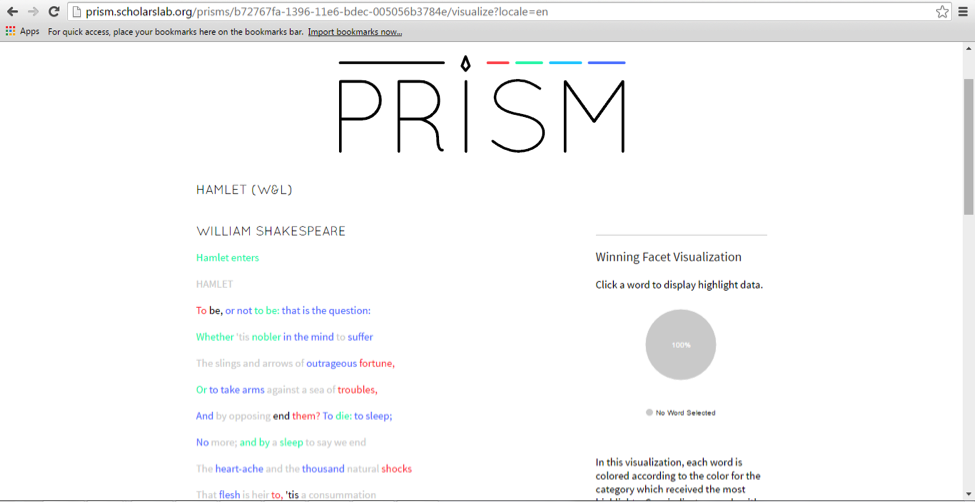
I also asked them to use Prism to mark up the monologue, indicating where Hamlet started moving, stopped moving, or changed position in their blocking. I did not tell them in which order to do these tasks just that they had to do both of them. At the end of the allotted 20 minutes, I taped all of the drawings on the board and pressed the visualization button on Prism to see what we found. The Prism results revealed that there was a great variety in blocking styles, yet there were definable loci of energy around certain parts of the text. (Here’s the full visualization)

In this first image, you can see that a lot of students notated something around “end them? To die; to sleep,” but there disagreement as to what Hamlet was doing at those moments.

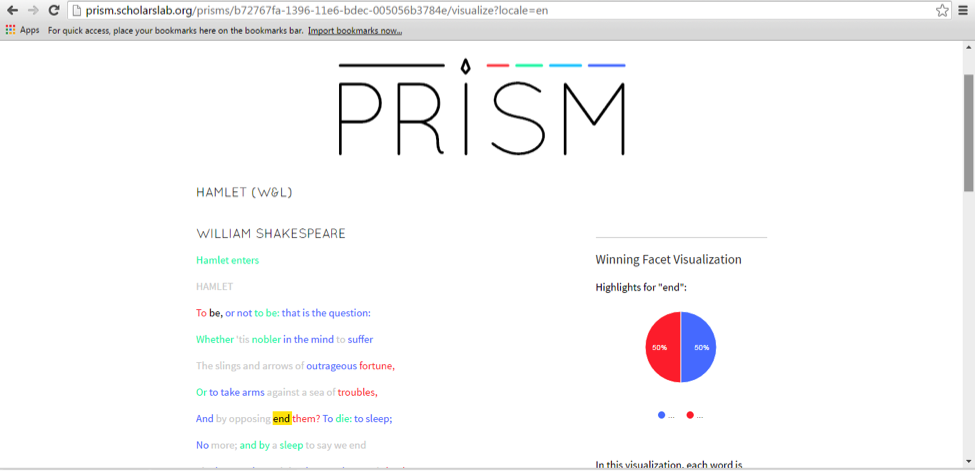
prism 1

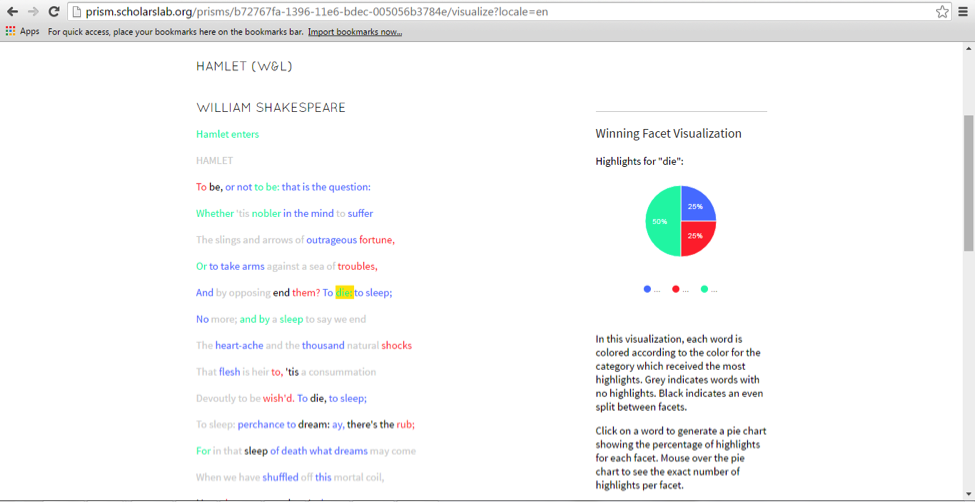
We zeroed in on the word “end” as Prism showed there was some debate as to what movement happened on that word. The Prism showed that students either had Hamlet change position without changing location (indicated by the blue) or stop moving all together (indicated by the red). No one had Hamlet begin moving on this word (which would have been indicated by green).

prism 2

Throughout the whole monologue, “die” and “death” continued to appear as words where students thought some kind of movement or position change should occur, but we couldn’t agree as to what that movement should be:

prism 3

prism 4

I have no definitive way to explain this: only a director’s hunch that there’s some sort of affective energy around the word and concept of death that we associate with anxiety that incites us to movement—we (or at least most of us) do not want to be still when facing death. Part of my future work is figuring out how to interpret these results.

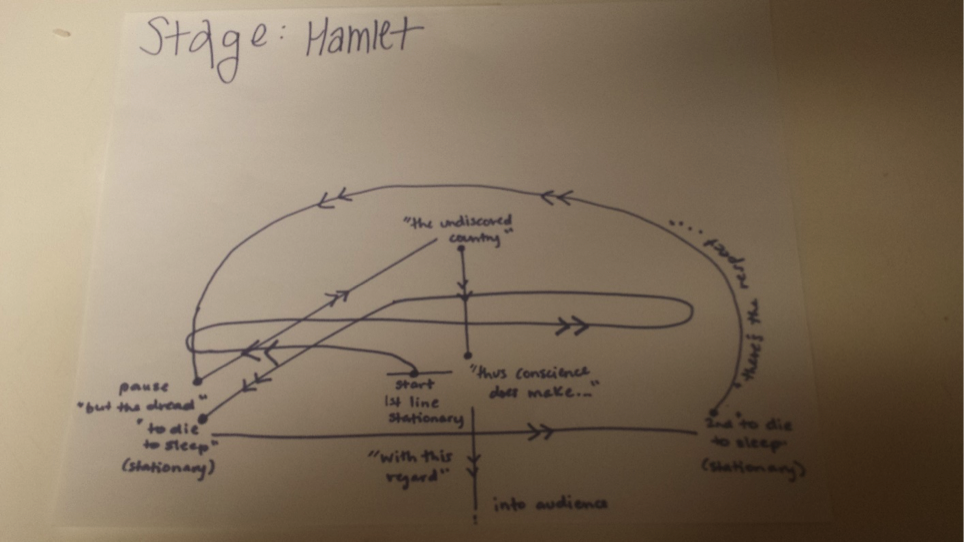
The other part of the activity—the drawings of Hamlet’s path—are much harder to read. Most drawings started Hamlet out on the center of the stage, not accounting for the first bit of text printed in the monologue directing that “Hamlet enters.” To me, this suggests some kind of connection between what we know about Hamlet, the role of this speech in the play, and center stage—we know Hamlet is the central figure and associate this important monologue with the center stage. But aside from that, the patterns varied. Most were well-balanced with Hamlet spending time on both sides of the stage (my mentors would be proud that both sides of the audience would get an equally good view of the actor). Some incorporated gestures or moments of intentional stillness. Many contained loops. Professor Pickett explained that she chose to do this in her drawing because of how she views the speech as rhetorically winding and wanted to create a movement pattern that reflected her reading.

Several of the students actually marked words on their drawings as well connecting the text directly to their movement patterns:

student hamlet

student hamlet 2

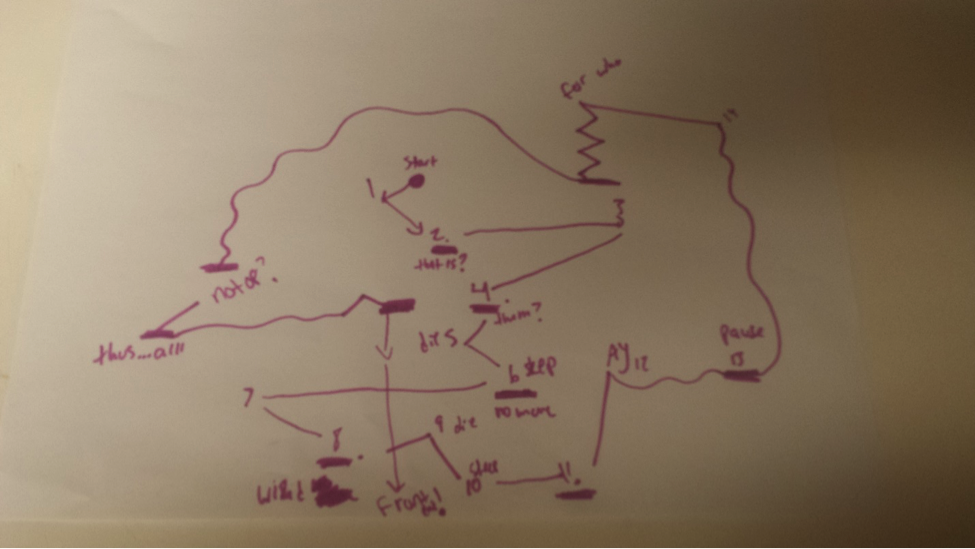
Some used no text at all and focused on the shape of Hamlet’s movements:

student hamlet 3

And here’s one that was purposely playing with Hamlet’s winding rhetoric:

student hamlet 4

So how do we make meaning out of all of this data?

I’m in the process (the slow, painful process) of developing a tool (or likely, a set of tools) to help students visualize the connection between play text and movement patterns. By considering the way language suggests movement will, I hope, allow for a richer consideration of the formal stylistics of particular plays, but also in the long run create corpus of data on the way people see theatre texts. I’m interested in what new areas of inquiry open up if I can use a digital tool to process many blocking patterns of the same scene (i.e. perform a kind of distant reading on the movement patterns that I had the students create). At the least, we can get students to think more deeply about the way that the dramatic text is a living document brought to life, challenged, and enriched by a consideration of the ways its interacts with the body, and embodiment.

This is important work for me both as a literary scholar and a theater director because of the reciprocal relationship between movement and interpretation. The director interprets the text to find places to block movement, and then the audience uses those movements to interpret certain moments on stage. Thinking about the relationship between movement and interpretation helps us to counter the belief that the playwright alone fixes the meaning of his or her “original text” and to recognize the larger networks of people, practices, traditions, and texts that make theater mean something.

[i] Broude, Roland. Performance and the Socialized Text. Textual Cultures: Texts, Contexts, Interpretation, Volume 6, Number 2, 2011, 24.

[ii] Ibid. 25.

[iii] Phelan, Peggy. Unmarked : The Politics of Performance. London ; Routledge, 1993.

[iv] It’s entirely worth noting that there should be a lively debate about if there are elements of performance that should not be recorded or analyzed as well. Is the kind of work we’re doing creating a richer context for talking about performances, or are we violently decontextualizing aspects of performance that can’t be understood without the full (but sadly unrecoverable) picture? (Many thanks to Purdom Linblad for first asking me a version of this question!)

[v] I was made aware of this interesting work in dance through sitting in on “The Art of Dance” taught by Kim Brooks Mata in the summer of 2015.

Categories
DH Project Update Research Projects

Reading Speech: Virginia Woolf, Machine Learning, and the Quotation Mark

[Cross-posted on the my personal blog as well as the Scholars’ Blog. What follows is a slightly more fleshed out version of what I presented this past week at HASTAC 2016 (complete with my memory-inflected transcript of the Q&A). I gave a bit more context for the project at the event than I do here, so it might be helpful to read my past two posts on the project here and here before going forward. This talk continues that conversation.]

This year in the Scholar’s Lab I have been working with Eric on a machine learning project that studies speech in Virginia Woolf’s fiction. I have written elsewhere about the background for the project and initial thoughts towards its implications. For the purposes of this blog post, I will just present a single example to provide context. Consider the famous first line of Mrs. Dalloway:

Mrs Dalloway said, “I will buy the flowers myself.”

Nothing to remark on here, except for the fact that this is not how the sentence actually comes down to us. I have modified it from the original:

Mrs Dalloway said she would buy the flowers herself.

My project concerns moments like these, where Woolf implies the presence of speech without marking it as such with punctuation. I have been working with Eric to lift such moments to the surface using computational methods so that I can study them more closely.

I came to the project by first tagging such moments myself as I read through the text, but I quickly found myself approaching upwards of a hundred instances in a single novel-far too many for me to keep track of in any systematic way. What’s more, the practice made me aware of just how subjective my interpretation could be. Some moments, like this one, parse fairly well as speech. Others complicate distinctions between speech, narrative, and thought and are more difficult to identify. I became interested in the features of such moments. What is it about speech in a text that helps us to recognize it as such, if not for the quotation marks themselves? What could we learn about sound in a text from the ways in which it structures such sound moments?

These interests led me towards a particular kind of machine learning, supervised classification, as an alternate means of discovering similar moments. For those unfamiliar with the concept, an analogy might be helpful. As I am writing this post on a flight to HASTAC and just finished watching a romantic comedy, these are the tools that I will work with. Think about the genre of the romantic comedy. I only know what this genre is by virtue of having seen my fair share of them over the course of my life. Over time I picked up a sense of the features associated with these films: a serendipitous meeting leads to infatuation, things often seem resolved before they really are, and the films often focus on romantic entanglements more than any other details. You might have other features in mind, and not all romantic comedies will conform to this list. That’s fine: no one’s assumptions about genre hold all of the time. But we can reasonably say that, the more romantic comedies I watch, the better my sense of what a romantic comedy is. My chances of being able to watch a movie and successfully identify it as conforming to this genre will improve with further viewing. Over time, I might also be able to develop a sense of how little or how much a film departs from these conventions.

Supervised classification works on a similar principle. By using the proper tools, we can feed a computer program examples of something in order to have it later identify similar objects. For this project, this process means training the computer to recognize and read for speech by giving it examples to work from. By providing examples of speech occurring within quotation marks, we can teach the program when quotation marks are likely to occur. By giving it examples of what I am calling ‘implied speech,’ it can learn how to identify those as well.

For this machine learning project, I analyzed Woolf texts downloaded from Project Gutenberg. Eric and I put together scripts in Python 3 that used a package known as the Natural Language Toolkit] for classifying. All of this work can be found at the project’s GitHub repository.

The project is still ongoing, and we are still working out some difficulties in our Python scripts. But I find the complications of the process to be compelling in their own right. For one, when working in this way we have to tell the computer what features we want it to pay attention to: a computer does not intuitively know how to make sense of the examples that we want to train it on. In the example of romantic comedies, I might say something along the lines of “while watching these films, watch out for the scenes and dialogue that use the word ‘love.'” We break down the larger genre into concrete features that can be pulled out so that the program knows what to watch out for.

To return to Woolf, punctuation marks are an obvious feature of interest: the author suggests that we have shifted into the realm of speech by inserting these grammatical markings. Find a quotation mark-you are likely to be looking at speech. But I am interested in just those moments where we lose those marks, so it helps to develop a sense of how they might work. We can then begin to extrapolate those same features to places where the punctuation marks might be missing. We have developed two models for understanding speech in this way: an external and an internal model. To illustrate, I have taken a single sentence and bolded what the model takes to be meaningful features according to each model. Each represents a different way of thinking about how we recognize something as speech.

External Model for Speech:

“I love walking in London,” said Mrs. Dalloway.  “Really it’s better than walking in the country.”

The external model was our initial attempt to model speech. In it, we take an interest in the narrative context around quotation marks. In any text, we can say that there exist a certain range of keywords that signal a shift into speech: said, recalled, exclaimed, shouted, whispered, etc. Words like these help the narrative attribute speech to a character and are good indicators that speech is taking place. Given a list of words like this, we could reasonably build a sense of the locations around which speech is likely to be happening. So when training the program on this model, we had the classifier first identify locations of quotation marks. Around each quotation mark, the program took note of the diction and parts of speech that occurred within a given distance from the marking. We build up a sense of the context around speech.

Internal Model for Speech:

“I love walking in London,” said Mrs. Dalloway. “Really it’s better than walking in the country.”

The second model we have been working with works in an inverse direction: instead of taking an interest in the surrounding context of speech, an internal model assumes that there are meaningful characteristics within the quotation itself. In this example, we might notice that the shift to the first-person ‘I’ is a notable feature in a text that is otherwise largely written in the third person. This word suggests a shift in register. Each time this model encounters a quotation mark it continues until it finds a second quotation mark. The model then records the diction and parts of speech inside the pair of markings.

Each model suggests a distinct but related understanding for how sound works in the text. When I set out on this project, I had aimed to use the scripts to give me quantifiable evidence for moments of implied speech in Woolf’s work. The final step in this process, after all, is to actually use these models to identify speech: looking at texts they haven’t seen before, the scripts insert a caret marker every time they believe that a quotation mark should occur. But it quickly became apparent that the construction of the algorithms to describe such moments would be at least as interesting as any results that the project could produce. In the course of constructing them, I have had to think about the relationships among sound, text, and narrative in new ways.

The algorithms are each interpretative in the sense that they reflect my own assumptions about my object of study. The models also reflect assumptions about the process of reading, how it takes place, and about how a reader converts graphic markers into representations of sound. In this sense, the process of preparing for and executing text analysis reflects a certain phenomenology of reading as much as it does a methodology of digital study. The scripting itself is an object of inquiry in its own right and reflects my own interpretation of what speech can be. These assumptions are worked and reworked as I craft algorithms and python scripts, all of which are as shot through with humanistic inquiry and interpretive assumptions as any close readings.

For me, such revelations are the real reasons for pursuing digital study: attempting to describe complex humanities concepts computationally helps me to rethink basic assumptions about them that I had taken for granted. In the end, the pursuit of an algorithm to describe textual speech is nothing more or less than the pursuit of deeper and enriched theories of text and speech themselves.

Postscript

I managed to take note of the questions I got when I presented this work at HASTAC, so what follows are paraphrases of my memory of them as well as some brief remarks that roughly reflect what I said in the moment. There may have been one other that I cannot quite recall, but alas such is the fallibility of the human condition.

Q: You distinguish between speech and implied speech, but do you account at all for the other types of speech in Woolf’s novels? What about speech that is remembered speech that happened in earlier timelines not reflected in the present tense of the narrative’s events?

A: I definitely encountered this during my first pass at tagging speech and implied speech in the text by hand. Instead of binaries like quoted speech/implied speech, I found myself wanting to mark for a range of speech types: present, actual; remembered, might not have happened; remembered incorrectly; remembered, implied; etc. I decided that a binary was more feasible for the machine learning problems that I was interested in, but the whole process just reinforced how subjective any reading process is: another reader might mark things differently. If these processes shape the construction of the theories that inform the project, then they necessarily also affect the algorithms themselves as well as the results they can produce. And it quickly becomes apparent that these decisions reflect a kind of phenomenology of reading as much as anything: they illlustrate my understanding of how a complicated set of markers and linguistic phenomenon contribute to our understanding that a passage is speech or not.

Q: Did you encounter any variations in the particular markings that Woolf was using to punctuate speech? Single quotes, etc., and how did you account for them?

A: Yes – the version of Orlando that I am working with used single quotes to notate speech. So I was forced to account for such edge cases. But the question points at two larger issues: one authorial and one bibliographical. As I worked on Woolf I was drawn to the idea of being able to run such a script against a wider corpus. Since the project seemed to impinging on how we also understand psychologized speech, it would be fascinating to be able to search for implied speech in other authors. But, if you are familiar with, say, Joyce, you might remember that he hated quotation marks and used dashes to denote speech. The question is how much can you account for such edge cases, and, if not, the study becomes only one of a single author’s idiosyncrasies (which still has value). But from there the question spirals outwards. At least one of my models (the internal one) relies on quotation marks themselves as boundary markers. The model assumes that quotation marks will come in pairs, and this is not always the case. Sometimes authors, intentionally or accidentally, omit a closing quotation mark. I had to massage the data in at least half a dozen places where there was no quotation mark in the text and where its lack was causing my program to fail entirely. As textual criticism has taught us, punctuation marks are the single most likely things to be modified over time during the process of textual transmission by scribes, typesetters, editors, and authors. So in that sense, I am not doing a study of Woolf’s punctuation so much as a study of Woolf’s punctuation in these particular versions of the texts. One can imagine an exhaustive study that works on all versions of all Woolf’s texts as a study that might approach some semblance of a correct and thorough reading. For this project, however, I elected to take the lesser of two evils that would still allow me to work through the material. I worked with the texts that I had. I take all of this as proof that you have to know your corpus and your own shortcomings in order to responsibly work on the materials – such knowledge helps you to validate your responses, question your results, and reframe your approaches.

Q: You talked a lot about text approaching sound, but what about the other way around – how do things like implied speech get reflected in audiobooks, for example? Is there anything in recordings of Woolf that imply a kind of punctuation that you can hear?

A: I wrote about this extensively in my dissertation, but for here I will just say that I think the textual phenomenon the questioner is referencing occurs on a continuum. Some graphic markings, like pictures, shapes, punctuation marks, do not clearly translate to sound. And the reverse is true: the sounded quality of a recording can only ever be remediated by a print text. There are no perfect analogues between different media forms. Audiobook performers might attempt to convey things like punctuation or implied speech (in the audiobook of *Ulysses*, for example, Jim Norton throws his voice and lowers his volume to suggest free indirect discourse). In the end, I think such moments are playing with an idea of what my dissertation calls audiotextuality, the idea that all texts recordings of texts, to varying degrees, contain both sound and print elements. The two spheres may work in harmony or against each other as a kind of productive friction. The idea is a slippery one, but I think it speaks to moments like the implied punctuation mark that come through in a particularly powerful audiobook recording.
Categories
Announcement DH Project Update Publication Research Projects

In Case You Missed the News

We’re caught up in the craziness of our four week spring term here at W&L, but we wanted to make sure you were caught up on some recent news from our DH community.

Ancient Graffiti Project wins NEH Digital Humanities Start-Up Grant

Heralded as the “epitome of liberal arts,” the Ancient Graffiti Project was recently awarded $75,000 to continue work on their database for textual and figural graffiti. Learn more from the W&L press release or the Atlantic Monthly article. Congrats to Sara Sprenkle, Rebecca Benefiel, and the rest of their team!


Stephen P. McCormick wins Mednick Fellowship from the Virginia Foundation for Independent Colleges

Stephen P. McCormick, Assistant Professor of French, has been awarded the 2016 Menick Fellowship by VFIC for his work on the Huon d’Auvergne project. Learn more about McCormick’s work on one of the last unpublished Franco-Italian Romance Epics from this article or dig into the digital edition yourself.


Joel Blecher publishes chapter on Digital Humanities pedagogy

Joel Blecher, Assistant Professor of Religion, won a DH Incentive Grant in fall of 2014 for incorporating data visualization into a History of Islamic Civilization course. You can now read about this experience in a new title from De Grutyer, The Digital Humanities and Islamic & Middle East Studies. Blecher’s chapter is titled, “Pedagogy and the Digital Humanities: Undergraduate Exploration into the Transmitters of Early Islamic Law” which you can read in print or electronic form through Leyburn Library.


Look forward to reports on our summer activities coming soon. We have teams going to DHSI, ILiADS, the Oberlin Digital Scholarship Conference, and more!

Categories
Announcement Undergraduate Fellows

Call for Participation: Undergraduate Fellowship Program

Call for Participation

DH @ WLU seeks applications for two Mellon Digital Humanities Undergraduate Fellows for the 2016-2017 academic year.

We’re looking for students who are curious about the ways that technology affects the world around them. You don’t have to be a software engineer to build a website or visualize data, but comfort around technology can set you apart in the job market or graduate school. The goal of this fellowship program is to give students the opportunity to develop technology skills and share what they’ve learned with others. This fellowship is broadly-defined and flexible to meet student skills and interests. Applicants without prior DH coursework are welcome to apply, but they will be encouraged to undertake a practicum project during the first semester of the fellowship to develop their technical skills in consultation with the digital humanities faculty.

Fellows will receive $10/hr and are expected to work 4-8 hours per week. Fellowships last one academic year but may be renewed. Fellows will report to Mackenzie Brooks, Assistant Professor and Digital Humanities Librarian.

Applicants should submit a statement of interest by May 31, 2016 to Mackenzie Brooks at brooksm@wlu.edu.

Position Description

Depending on their skills and interests, students will be expected to perform some the following:

  • Serve as lab assistants in DH courses with lab components or DH studio courses.
  • Staff the future DH Space (potentially after working hours) and serve as tutor/mentor for students seeking assistant on DH assignments.
  • Participate in outreach activities with and without DHAT/DHWG members (ex: visiting classes, connecting with student groups, presenting at conferences).
  • Contribute to the DH @ WLU blog on a regular basis.
  • Develop personal DH research projects or contribute to library DH projects.
  • Collaborate/mentor with other fellows or student groups on specific projects.

Qualifications

  • Willingness to engage with technology (prior experience not required).
  • Interest in humanities and social science-based research questions.
  • Comfort with independent research and skill development.

Statement of Interest

Your statement of interest should include the following in one page or less:

  • Your (prospective) major(s).
  • Your fall term schedule and availability.
  • What you hope to gain from this fellowship experience.
  • Your interest in digital humanities methodology, as it relates to your scholarship and your own skills/experience.

This fellowship program is made possible by a grant from the Andrew W. Mellon Foundation.

Undergraduate Fellows Winter 2016

Categories
DH Project Update Undergraduate Fellows

Lasso-ing the Laisses: A Digital Journey Through Annotations, Javascript, and More!

Guest post by Sarah Schaffer ’16

Introduction

Hi, my name is Sarah and I am a senior Business Administration major with a French minor. This past semester of independent study I worked with Professor McCormick on his current Huon d’Auvergne project. You may be wondering: “What is a business major doing here?” but in the spirit of a liberal arts college I’ve taken advantage of the wide variety of classes offered here. My journey with Digital Humanities began Winter 2015 when I registered for Professor McCormick’s class French 341: La Legende Arthurienne, which included a Digital Humanities lab. It was in this class that I became fascinated with TEI and how Digital Humanities have transformed our interactions with various works.

Before Digital Editions

The first step of research was to understand the importance of the work itself, before it becomes a digital edition. Through reading both the books Introduction to Manuscript Studies and On Editing Old French Texts, I began to better understand the work that Professor McCormick was doing. As someone without much background knowledge of historical manuscripts, it had never crossed my mind to consider even half the elements discussed. Each element, such as the writing support it’s written on, the manuscript errors, corrections made, and annotations, add to the way the document is understood and interpreted. Every new edition of the work needs to take into account the editor’s personality and what they chose to include or exclude. Each component plays such a huge role in editing and choosing what to display on the digital edition that is being presented. This makes choosing what to include even more important in the way that the text is being displayed and available for interpretation.

Theory of Digital Editions

As I moved from my readings about the physical documents themselves, Professor McCormick and I discussed Peter Robinson’s article “The Theory of Digital Editions.” Digital editions in their infancy tried to include everything, but quickly found that resources are limited which restricted what could be included. However, what digital editions can do is include a new level of involvement with the document between both the reader and the editor, something that is not possible with a printed document. Unlike a primary document or editorial text, a digital edition allows the reader “to see the text of the document construct itself, layer by layer, from blank page to fully written text” (Robinson 110). The article and discussion with Professor McCormick opened my eyes to the idea that the text-as-document is intimately linked to the text-as-work within the digital edition.

Putting Ideas Together

While learning about digital editions, I researched the different ways other digital editions included annotations, the platforms they used, and the way their works were displayed. I spent a large amount of time looking through various digital editions and searching through DIRT for tools we could use for the final website. We looked into using Hypothes.is as an annotation tool, but it didn’t quite provide the functionality that we were looking for. Eventually after researching and working with various different platforms, we decided to build our own system, using Ruby on Rails. Instead of trying to tailor an already made platform to the project’s needs, creating a new system allowed for the upmost customization.

Prototyping

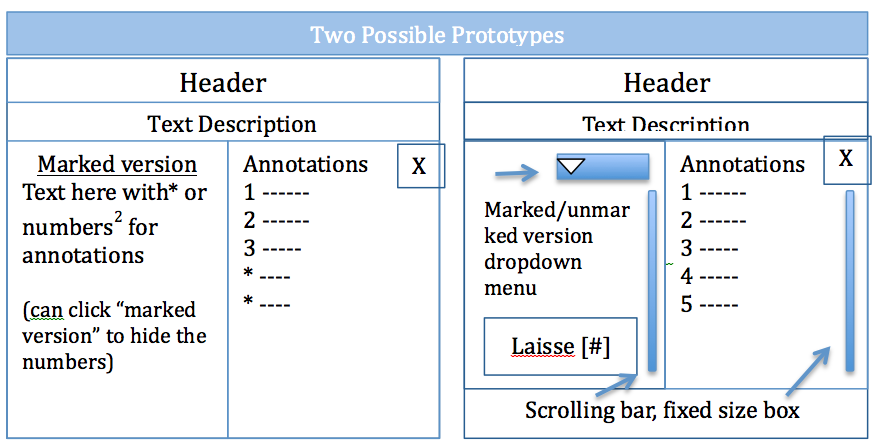
If I could look at different examples of digital editions and click through them all day, I would, but at some point I needed to come up with some ideas on my own. Based off of various other editions, understanding the history and theory of digital editions, and being aware of what Professor McCormick was looking for I got to work. The best way to begin prototyping is just sitting down with some blank sheets of paper and a pencil and draw out what to design. So, I got to work sketching out several ways the website could be organized. Once I had one or two ideas down, I found more ways to organize the various laisses and show functionality as well. A laisse is best defined as a narrative unit, similar to a stanza but varies in length. Each version of Huon d’Auvergne has a large number of laisses, which makes the organization and display of them even more important. Below you’ll see some basic prototypes created for the display of different versions of Huon d’Auvergne laisses and the annotations.
Screen Shot 2016-04-11 at 9.56.27 AM

Coding

The final step of my project was to begin building the prototypes that I had created. Luckily, I’ve had some experience coding in Professor McCormick’s class before, as well as during some business classes so the task didn’t seem too daunting. I got to work on learning javascript and jQuery through the courses on Codecademy – a website I highly recommend if you’re trying to learn a new coding skill. Once I learned the basics, I did a quick review of HTML and CSS to prep myself for creating a mock-up website. I forgot how intimidating it is to stare at a blank text editor, but once I got started it didn’t seem nearly as daunting.

Gif of frustrated woman staring at laptop

I worked with basic text generated from Lorem Ipsum in order to more easily put my new coding skills to work. After setting up basic structural parts of the website to work with, I added some CSS styling. I then continued with the javascript portion of the website and worked through hiding and revealing the different laisses. I struggled with this part the most because it was such a new skill. Much like learning a foreign language, every new programming language takes time and effort to work through figuring out a solution.

Reflecting on the Semester

Overall, this past semester has been a great learning experience. Beyond the new skills that I learned, this opportunity allowed me to take my liberal arts education beyond the classroom and apply it to a really unique project It was an honor to work with Professor McCormick’s team and be a part of such an incredible project.

Work Cited:

Robinson, Peter. “Towards a Theory of Digital Editions.” The European Society for Textual Scholarship 10 (2013): 105-31. Web.

Categories
Undergraduate Fellows

Reflecting on the Fellowship  

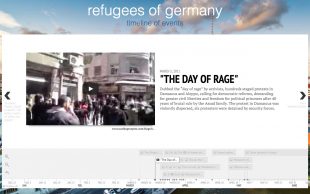
The culmination of my time under the Mellon Digital Humanities Undergraduate Fellowship semester has been my website titled Refugees of Germany. This process has…

Given me space to design something from scratch (i.e. Ruby on Rails and Python). Not having studied computer science formally since high school, it has been incredibly formative to learn about the process of website design, and even get my feet wet in learning some code. In doing so, I was able to collaborate with friends in the computer science department who were extremely helpful in the structuring of the back end. I attribute my basic HTML and CSS familiarity and knowledge to a crash-course provided by Mackenzie and Brandon, and I was able to subsequently take advantage of
Codecademy, which I highly recommend to anyone trying to learn programming.

Allowed me to delve into the Syrian refugee crisis and better understand its history, magnitude, and implications. All of this was accomplished in the research that led to the creation of the digital timeline now featured on my website. Approaching my summer with this perspective is something that I can now reflect on as a crucial step in preparation for my time in Berlin.

Prepared a skeleton that will alleviate my work in Germany: I can wholly focus on conducting interviews, analyzing major themes, and representing these online. The weeks and months spent this semester have allowed me to accomplish the goal I set out for myself at the onset of the semester. I now have a container that I can fill with data I acquire this summer. The website can now serve as a platform for all of my research, and can be easily updated in real time!

Endowed me with respect for the power of images and storytelling via an online media. Reading and learning about the Syrian Civil War and the stories that accompany those who experienced it have had a profound impact on me. It has reinforced my motivation and endeavor to get to know those who have been personally affected by projecting their voices and stories, getting to know them better, and hearing their side of the story.

Humbled me with the recognition of the way the virtual can impact reality, and how we all can have an active part in telling history. Ultimately, what we experience through a website can fundamentally change how we behave and perceive reality. I believe that the information filtered through Western media has been incredibly one-sided and “self”-oriented. Hearing from both refugees and Germans on the ground and portraying those experiences on my website so that they are perceivable to all is a fascinating concept, and one that I believe to be increasingly important. We all have a role in telling our own history and understanding others’ histories as subjective truths.

Due to a technical glitch, the live site is no longer available. I have pasted below some screen shots including a brief glance at my summer’s work. Please feel free to contact me (carlm17@mail.wlu.edu) if you have any questions or would like to hear more!

homepagemahmed_1nalah_2timeline1

Categories
Incentive Grants Pedagogy

Michelle Brock on “Choose Your Own Witch-trials”

Enjoy this post by Michelle Brock, Assistant Professor of History and DH Incentive Grant Awardee 2015-2016

The Idea:

My course on the Age of the Witch-hunts is designed to introduce students to one of the most fascinating and disturbing events in the history of the Western world. Between 1450 and 1750, at least 100,000 individuals, mostly women, were accused of witchcraft in Europe and North America. Of these, roughly half met their demise at the stake or in the noose. A variety of social, religious, judicial, and political causes, none of which is singularly responsible, lurk behind this tragedy. Over the course of the semester, this class examines the litany of complex reasons for the witch-hunts, asking why they occurred when and where they did, why certain people were accused, why the trials finally ended, and how scholars from a multiple disciplines continue to grapple with this topic.

In designing a final project for teaching this course in Winter 2016, I kept thinking of the Choose Your Own Adventure gamebook series that I loved as a child. In these short, interactive works, the reader plays the protagonist of the story, making choices that lead down surprising paths, ultimately shaping the plot and the ending. I knew I wanted to create a similarly interactive assignment for my Age of the Witch-hunts class. With the help of the Mackenzie Brooks and Brandon Bucy at the W&L Library and Academic Technologies, I designed the “Choose Your Own Witch-trial” project to allow my Age of the Witch-hunts students to explore regional differences in the European witch-trials in a fun, collaborative, and informative way.

The reasons for using the Inklewriter interactive format rather than assigning a traditional research paper, were threefold. First, this method encouraged students to pay close attention to historical detail and contextual specificity, and to recognize the difficulty in forming broad causal explanations for such phenomena. Second, I suspected this project would be interesting and collectively engaging in ways that an individual, traditional research paper would not be. Last, the textual gaming method allowed students, as both creators and players of the games, to place themselves in the shoes of those who observed, orchestrated, and, most important, fell victim to the witch-hunts. This, I hope, helped to build empathy and understanding of world-views profoundly different than theirs while also providing an opportunity for reflection about our own belief systems and choices. Throughout, I reminded my students that while these games were supposed to be fun to create, any entertainment factor ought not obscure the fact that the witch-hunts were a genuine human tragedy that claimed tens of thousands of innocent lives.

The Project:

For this project, students worked in pairs to create text-based games using Inklewriter, a free tool that allows users to write interactive stories with twists, turns, and a variety of possible endings. Each pair was assigned a region in early modern Europe that experienced significant levels of witch-hunting. Despite important shared themes, there existed remarkable variety in the nature of witch belief and witch-hunting in different areas. For example, while 85% of those tried for witchcraft in Western Europe were women, the majority of the accused in Russia were male. While the use of torture during trials frequent in the very decentralized Holy Roman Empire, it was illegal in England, where the courts were tightly controlled. In Calvinist Scotland, possession cases rarely attended outbreaks of witchcraft, while the two were often linked in France. Students were accordingly asked to conduct significant historical research into the witch-trials in their specific region. They turned in annotated bibliographies of their sources early in the semester, as well as papers explaining the historical background of their games at the end of the term.

When creating their “Choose Your Own Witch-trial” game, each pair of students made their game model the nature of the witch-hunts in their specific region, paying close attention to the types of people accused, the chronology of the trials, the standards of evidence, the religious climate of the area, the types of punishment doled out, etc. Their games began with the initial accusation and continued through to the ultimate verdict. Groups had the option to write from the perspective of a third party observer, a jury member (if applicable), the orchestrators of the trial (often a clergyman or a local magistrate), or the accused witch. All but one group chose the perspective of the accused witch. At the end of the semester, the class collectively played all of the games over the space of two class periods (each pair taking 20-25 minutes for their game and following Q&A), after which each student wrote a final essay noting the regional variations they observed and examining what factors seem to have most shaped the course, chronology, and severity of the trials across Europe.

Assessment and Evaluation:

The project was assessed in three ways: the quality, accuracy, and creativity of the final games; the annotated bibliographies and historical background essays turned in by each student; and the response essays to the class gameplay. While I set minimum parameters for sources, the length of the games, and the attendant papers, the students were otherwise left to determine the content and course of their games. I did not want to give so much direction that it would stifle creativity; really, I just wanted to see what the students would come up with. I required each pair to meet with me no later than the week before the games were due in order to assess their progress and catch any potential technological or content issues in their games. Much to my surprise, not one group had any trouble using the software after it had been explained by Brandon Bucy at the start of the project. The lesson here, of course, is that my students are much savvier with technology than I am!

The overall quality of the games was generally quite high, and students reported that this was one of the most engaging and informative assignments they had encountered in their college career thus far. Next time I assign this project, I plan to increase the minimum length of the games by requiring students to include more background and more choices for the player, as some games were noticeably longer and more detailed than others. Other than this, however, I was thrilled by the results and would highly recommend the use of Inklewriter for the creation of text-based games in the college classroom.

The Games:

France

Scotland

Poland

Denmark

England

Russia

Categories
Event on campus Project Update Undergraduate Fellows

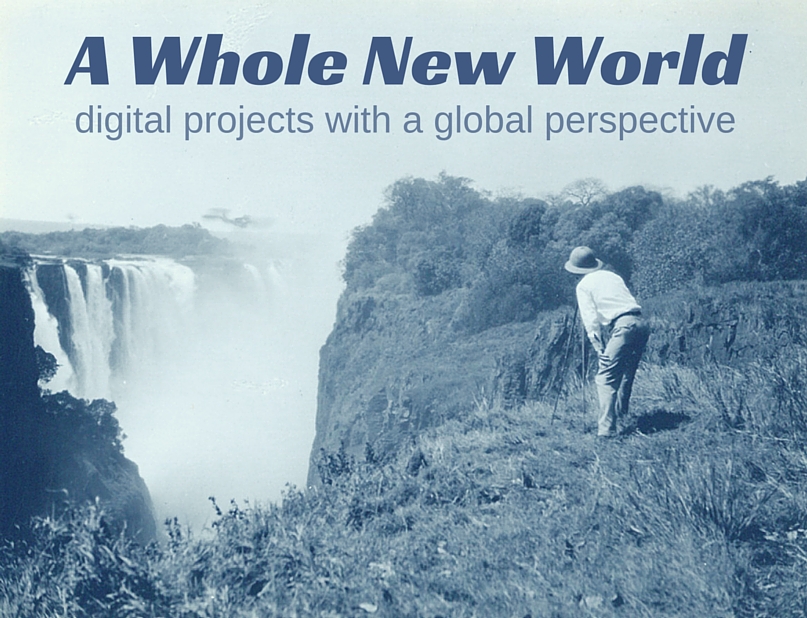
A Whole New World: Digital Projects with a Global Perspective

A Whole New World

Thursday, April 7, 2016
Center for Global Learning
Room 211
12pm-1pm


Join us for project updates from three students conducting independent digital humanities research this term. In this poster presentation-style forum, students will present on the content of their research – 1920s Africa through Western eyes, the refugee crisis in Germany, and a Franco-Italian romance epic – as well as their methodology – HTML, CSS, PHP, Ruby on Rails, and Javascript. Refreshments provided.

Lions, Jungles, and Natives
Arlette Hernandez ’18
Mellon Digital Humanities Undergraduate Fellow

The Refugees of Germany
Matt Carl ‘17
Mellon Digital Humanities Undergraduate Fellow

Huon d’Auvergne Digital Edition
Sara Schaffer ‘16
Independent Study with Prof. Steve McCormick


This program is sponsored by the Andrew W. Mellon Foundation and a Dean of the College Cohort Grant.